
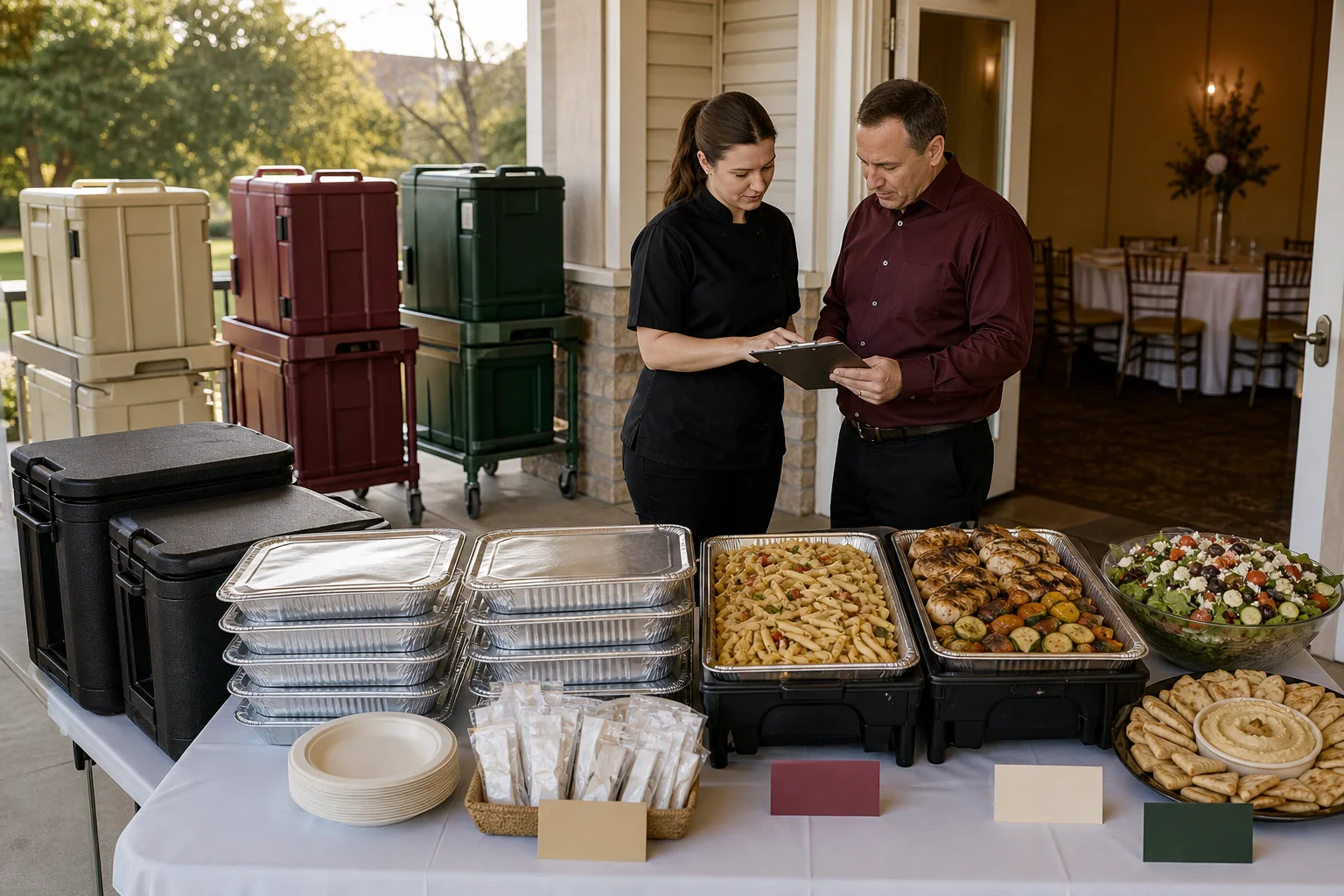
A catering order can be correct on paper and still arrive at the wrong door.
The food may be ready at 5:00, while the venue does not unlock until 5:15. The host may be decorating a ballroom and miss the phone. The front entrance may have stairs, while the useful loading entrance is behind the building. A church kitchen may have an oven but prohibit outside users from turning it on. A community room may provide tables but no serving utensils. A Plymouth office may have two suites with nearly identical names. A Westland family gathering may be held at a park facility whose gate closes before cleanup ends.
These are not menu problems. They are handoff problems.
L.A. Bistro Canton is located at 44314 Cherry Hill Road in Canton, Michigan. Its catering menu includes Italian and Mediterranean main courses, sides, appetizers, salads, handhelds, and baguettes in published tray or piece formats. Whether the event is in Canton, nearby Plymouth, or Westland, the host still needs to connect that order to a real destination, responsible person, setup surface, and service time.
This guide is the missing field plan between “order confirmed” and “guests can eat.”
One order, three clocks
Every catered event runs on three clocks:
- The restaurant clock: when the food is scheduled to be ready
- The travel clock: when it leaves L.A. Bistro and reaches the venue
- The guest clock: when people expect to begin eating
Those times should not be identical.
If the food-ready time and meal time are both written as 6:00 p.m., there is no room for loading, transportation, finding the correct entrance, checking the order, carrying trays inside, arranging the service table, or solving a missing utensil. On the other hand, bringing hot food far too early can create a holding problem the venue is not equipped to manage.
Work backward from the guest clock.
Write the meal time first. Subtract a realistic setup window. Subtract a transportation window based on the actual day, address, weather, construction, and traffic—not a remembered drive on a quiet morning. Add loading and order-check time. The result is the target restaurant-ready time to discuss with L.A. Bistro.
Do not publish that draft timing to guests until the restaurant and venue have confirmed what each can support.
The dispatch card: put the whole handoff on one page
Create one paper or shared note called the dispatch card. It should contain:
- L.A. Bistro Canton, 44314 Cherry Hill Road, Canton, MI 48187
- Restaurant phone: (734) 392-7028
- Event venue’s complete street address
- Building, suite, room, pavilion, or entrance name
- Venue contact and mobile number
- Food pickup or confirmed arrival time
- Guest meal time
- Name and mobile number of the person receiving the order
- Parking or loading instructions
- Number of trays, platters, bags, and special meals expected
- Dietary labels that must stay with specific items
- Equipment and utensils the restaurant is providing
- Equipment and utensils the venue or host is providing
- Payment status and person authorized to resolve a discrepancy
Give the card to the pickup driver, venue receiver, and event lead. A screenshot of a menu is not a handoff plan.
Canton events: nearby does not mean automatic
For a Canton event, the restaurant and venue may share a city name. That can reduce geographic complexity, but it does not remove logistics.
Canton addresses span private homes, offices, schools, houses of worship, parks, clubhouses, and event spaces. The last few hundred feet may take longer than expected when the correct door is not visible from the road. A large building can have separate guest, staff, kitchen, and loading entrances.
Ask the venue:
- Which entrance accepts outside food?
- Can a vehicle pause there long enough to unload?
- Are carts available?
- Are stairs, elevators, locked doors, or long hallways involved?
- How early can the room be entered?
- Is the serving table already placed and covered?
- Is there a prep sink, refrigerator, oven, or warming equipment—and may an outside caterer or host use it?
If the event is at a residence, identify a clear countertop or table before the food arrives. Move decorations, gifts, mail, and personal items away. Decide whether guests will enter through the same door used for unloading. Keep pets and children clear of hot or heavy trays during the handoff.
Same-city catering works best when the host uses proximity as flexibility, not as a reason to delay planning.
Plymouth events: solve the exact-room problem
“The event is in Plymouth” is a starting point, not a destination instruction.
The mailing city, municipality, venue name, and room name may not answer the driver’s most practical question: where does the food go? A downtown office, recreation room, private home, school facility, and rented hall each create a different final approach.
For a Plymouth event, send a dropped map pin if the formal address points to a large property or an entrance guests do not use. Include the room or suite name in plain language. If parking is time-limited or distant, arrange a receiver with a cart at the agreed door.
Do not make the person transporting food search a directory while hot trays wait in the vehicle.
If an elevator is required, confirm its hours and whether it can accommodate a loaded cart. If the venue shares a lobby with other businesses, tell the front desk or security team that a restaurant order is expected. If the event takes place after normal business hours, make sure the receiver has building access before leaving for the restaurant.
The host should also verify whether the venue permits outside catering and whether it requires a certificate, vendor form, kitchen fee, cleanup deposit, or proof of insurance. L.A. Bistro can answer questions about its food and agreed service; only the venue can state its facility rules.
Westland events: give the route uncertainty somewhere to go
For a Westland event, avoid choosing the departure time from one generic navigation estimate. A route forecast can change with the exact part of the city, time of day, road conditions, weather, and temporary delays.
The solution is not an enormous blanket cushion that leaves dinner waiting too early. The solution is a staged plan:
- Confirm the restaurant-ready time.
- Check current conditions shortly before departure.
- Protect a setup interval at the venue.
- Give the receiver a live update when the order leaves Canton.
- Keep the food in appropriate carriers until the service table is ready.
If the Westland venue has a controlled gate, school security desk, park attendant, or locked community-room entrance, arrange access in advance. Put the contact’s mobile number on the dispatch card and confirm that the phone will be audible during setup.
For outdoor or park events, ask about power, shelter, tables, food-holding rules, waste removal, and closing time. Weather affects more than the drive. Wind can disrupt labels and coverings; heat or cold can shorten the practical service plan; rain can make an uncovered path unusable. Build a permitted indoor or sheltered fallback with the venue.
Decide who is actually transporting the food
Never use the word “delivery” unless delivery has been explicitly confirmed for this order and address.
A restaurant that offers catering food does not necessarily provide transportation, staffed setup, or on-site service for every order. The host may need to arrange pickup. Availability, range, timing, fees, and minimums can change. Ask L.A. Bistro directly.
If the host is picking up, choose the vehicle intentionally:
- Clear a flat cargo area before arrival.
- Keep trays level and secured against sliding.
- Do not stack items beyond what their lids and packaging can support.
- Separate chilled items from hot items as advised.
- Bring clean insulated carriers if they are not part of the confirmed order.
- Assign a second adult when the order is too large to load and navigate safely alone.
- Keep the passenger area free of loose decorations, sports equipment, or shopping bags that could shift into food.
Ask how many packages to expect. “Ten trays” may also include salad bowls, bread bags, sauces, utensils, and separately packed dietary meals. Vehicle capacity should be based on the complete order, not the number of entrées.
Make a tray manifest before anything moves
A tray manifest is a countable list of every item leaving the restaurant.
For example:
- 1 full tray Penne Palomino
- 1 half tray Chicken Piccata
- 1 full tray rice
- 1 half tray vegetables
- 1 full tray Mediterranean Salad
- 1 hommous tray plus included bread
- 30 appetizer pieces
- 2 separately identified meals
- 6 serving utensils, if confirmed
- Plates, cutlery, napkins, warming equipment, or other supplies only if confirmed
This is an example of organization, not a recommended menu or quantity.
At pickup or handoff, one person reads the manifest while another points to each package. Check lids, labels, sauces, bread, and small bags. Confirm that the separate dietary meals are identifiable without opening every container.
The catering quantity worksheet explains how to translate guest demand into the menu’s current piece counts and serving ranges. The manifest begins after those quantities have been decided.
Build the service table before the food arrives
The table should not be an improvised surface discovered during unloading.
Plan the guest flow from empty plate to completed plate. Put foods in an order that makes sense, but protect dietary arrangements from casual mixing. Provide a dedicated utensil for every tray. Place labels where they remain connected to the correct food even after lids move.
If the venue supplies warming equipment, confirm who sets it up and who is trained or permitted to use it. Do not light, plug in, or operate unfamiliar equipment based on assumption. Follow the restaurant’s and venue’s food-handling instructions.
Create space behind or beneath the service area for replacement trays and packaging. Keep guests away until the receiving check is finished. Opening the line while trays are still being counted makes discrepancies harder to identify and lets serving utensils migrate before dietary items are protected.
For an office, include a surface for plates and cutlery that does not block a hallway or emergency exit. For a house, protect furniture and floors from heat and spills. For a hall, learn the venue’s table-linen and cleanup rules.
Labels need meaning, not just names
An effective label can answer several questions:
- What is the dish?
- Which confirmed dietary statement applies?
- Does it contain a known major allergen?
- Is it reserved for a specific guest group?
- Which serving utensil belongs with it?
Only publish claims the restaurant has confirmed for the exact order. A vegetarian label is not a halal guarantee. A halal-certified meat source does not automatically establish every sauce, cheese, stock, utensil, or shared-equipment condition. “Dairy-free,” “nut-free,” and “gluten-free” should never be guessed from appearance.
For detailed halal-conscious questions, use the Canton and Plymouth catering guide as a discussion checklist, then confirm current sourcing and procedures with L.A. Bistro.
If a guest has a serious allergy, contact the restaurant before ordering and explain the need precisely. The restaurant can state what it can and cannot accommodate. The host should not promise a safety condition that has not been confirmed.
The receiver owns the moment of truth
The venue receiver has one job during handoff: focus on the food.
This person should not also be giving a speech, taking family photographs, managing children, or driving from another location. They need the manifest, both phone numbers, access credentials, and authority to make a small decision if something differs from the plan.
During handoff, the receiver should:
- Direct the food to the correct entrance and table.
- Count packages against the manifest.
- Identify special meals and labels.
- Confirm which supplies are included.
- Note any visible packaging issue immediately.
- Follow the agreed holding and setup instructions.
- Tell the event lead when the food table is ready.
If a problem appears, call L.A. Bistro promptly with the order name and a specific description. “Something is wrong” slows resolution. “The manifest lists two salad bowls and I have one” creates a checkable question.
Plan the end before the beginning
Catering does not end when the first guest builds a plate.
Assign someone to monitor the table, protect utensils, and close or replenish items as instructed. Decide when service ends. Ask the venue where waste, recycling, and used equipment go. Know which carriers, racks, or other items must be returned if any were provided under the agreement.
For leftovers, have suitable containers, labels, refrigeration access, and a responsible person. Follow food-safety guidance from the restaurant and relevant authorities. Do not leave food at room temperature through a long program and then send it home as though time had stopped.
If the host wants specific families or staff to receive leftovers, write that plan down. Otherwise, cleanup volunteers may make conflicting decisions under time pressure.
A 48-hour logistics check
Two days before the event—or at the deadline agreed with the restaurant—read these statements aloud:
- The final food order and quantities are confirmed.
- Pickup or any other transportation arrangement is confirmed, not assumed.
- The restaurant-ready time and guest meal time are different and workable.
- The venue address, entrance, room, and access window are exact.
- A named receiver will be present with a working phone.
- The complete manifest is available.
- Every special meal has a confirmed label and service plan.
- Tables, utensils, holding equipment, plates, and cleanup supplies have owners.
- The venue permits outside catering and the planned equipment.
- Leftovers and equipment returns have a plan.
Any sentence that cannot be said confidently is a task, not a detail to hope resolves itself.
Contact the restaurant with the destination in hand
Before calling, know whether the event is in Canton, Plymouth, or Westland; have the full address; understand the venue’s access rules; and decide the actual meal time. Review the current catering menu, then call (734) 392-7028 or contact L.A. Bistro Canton to discuss current availability, ordering deadlines, packaging, quantities, and transportation options.
If moving the meal introduces more complexity than the event needs, compare off-site catering with a large-group restaurant dinner or an entire-room event.
The best local catering experience is not defined by crossing a city line. It is defined by a complete chain of custody: the right food, counted at the restaurant, transported under a confirmed plan, received at the correct door, arranged in a prepared space, and served when guests are ready.