
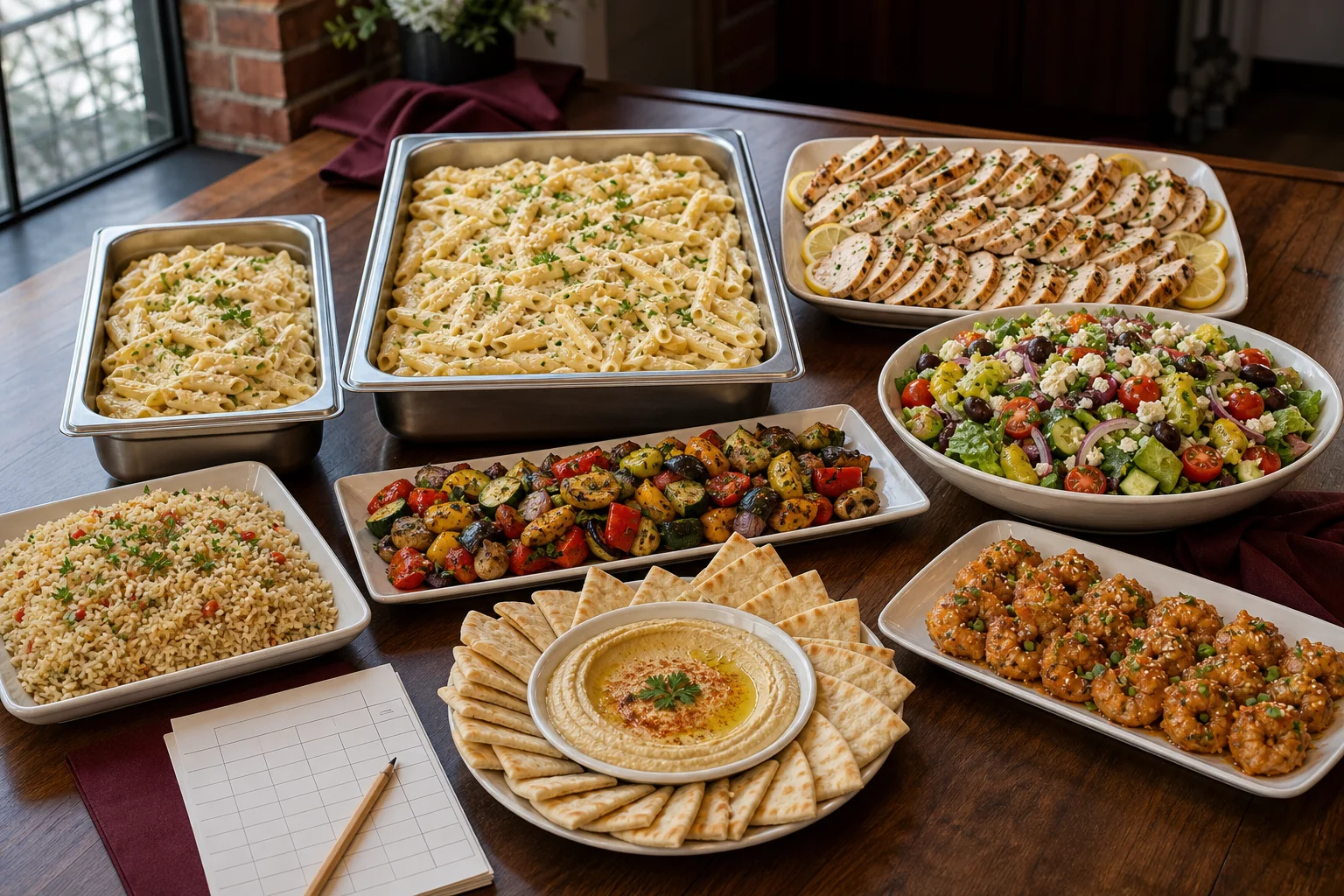
Ordering catering for 30 people does not mean finding one tray labeled “serves 30” and repeating it across the menu.
That shortcut ignores the way people actually eat.
A two-hour open house, a seated graduation dinner, an office lunch, and a children’s birthday can each have 30 names on the guest list while requiring very different food quantities. Arrival patterns change. Appetizer demand changes. Some guests take a full serving of every dish; others skip half the table. A broad menu spreads demand across more choices, while one celebrated entrée concentrates it.
The useful question is not simply, “How many people does this tray feed?” It is:
How many guests are likely to take this item, how much of it counts as one serving in this event, and what else will be offered beside it?
L.A. Bistro Canton’s published catering menu gives hosts several kinds of quantity information. Main-course trays are listed by pieces. Sides, salads, and hommous use serving ranges. Appetizers can be priced per piece. Sandwiches, burgers, rollups, and baguettes are sold in four- or eight-item trays. Those units are useful, but they cannot make the event decisions for you.
This worksheet can.
Start with a four-number headcount
Do not write only one total at the top of the page. Write four numbers:
- Confirmed adults and teens
- Confirmed younger children
- Unanswered invitations or likely walk-ins
- Vendors and staff who will eat
The fourth number is the one hosts often forget. A photographer working through dinner, a coordinator on site for six hours, or a small setup crew may need a meal even if they are not seated with guests. Ask instead of assuming.
Children should not automatically be counted as either zero or one full adult. Age, event time, and menu familiarity matter. A teenager at a post-game dinner may eat more than an adult at a short afternoon shower. A toddler may eat only a few bites. Record the age range, then describe it when you speak with the restaurant.
Unanswered invitations require judgment. If the venue cannot accommodate unexpected guests, resolve the attendance first. If the gathering is deliberately casual and people may arrive throughout a window, include a modest uncertainty allowance. A buffer should cover plausible attendance and normal serving variation—not turn into a second full event.
Give every guest an “eating window”
Next to the headcount, write when food becomes available and how long it remains the main activity.
A short office lunch
People often arrive together, build one plate, and return to work. Demand is concentrated, and the line needs to move. Handheld choices or a simple main-side-salad combination can make the quantity plan easier to understand.
A two-hour open house
Guests arrive in waves. The same platter may look generous at the start and sparse when a later group enters. Smaller replenishment batches can preserve presentation, but they require someone to manage the food table.
A seated celebration
Everyone expects a complete meal at roughly the same time. Appetizers may be lighter if a substantial dinner follows promptly. Sides and mains need to work together as a composed plate.
A meeting that crosses a meal period
If people have been working for hours before food appears, expect the meal to carry more weight. If pastries or snacks were already served, that context matters too. The corporate-event planning guide explains how an agenda can shape the meal.
Timing turns a raw guest total into a useful forecast.
Read the catering menu’s units literally
The categories on L.A. Bistro’s current catering menu do not all use the same definition of a half or full tray.
Main courses: 15 pieces or 30 pieces
The main-course table labels half trays as 15 pieces and full trays as 30 pieces. That is a piece count—not a blanket promise that every half tray feeds 15 guests in every menu combination.
For a piece-based chicken entrée, begin by deciding how many pieces form the intended serving. Then ask whether guests will also have pasta, rice, vegetables, salad, appetizers, or another main. If two mains share the spotlight, not every guest will necessarily take a full serving of both. If one chicken selection is the only entrée, demand will concentrate on it.
Pasta trays appear in the main-course section under the same published tray headings. Before doing arithmetic, ask L.A. Bistro how the listed piece convention applies to the exact pasta selection and event. Clarifying the unit is better than assigning your own meaning to it.
Sides: ranges of 10–12 or 20–25
Rice, mashed potatoes, vegetables, and potato wedges are currently listed with half-tray ranges of 10–12 and full-tray ranges of 20–25.
A range is honest because serving size varies. If rice is one of three sides, an individual scoop may be smaller. If rice is the only base for a sauced entrée, guests may take more. Serving utensils matter: a large spoon can turn an assumed portion into something much bigger in the first ten minutes.
Use the low end of the published range when the side is central, the event runs long, or self-service portions may be generous. The upper end may be more realistic when several comparable sides divide demand. Confirm the final mix with the restaurant.
Appetizers: serving ranges and per-piece counts
Hommous is listed by tray, with a half tray serving 10–15 and a full tray serving 25–30. The menu also specifies 36 pieces of bread with a half tray and 60 with a full tray.
Caprese, ravioli, Firecracker Shrimp, and Crispy Firecracker Chicken are listed per piece. This makes planning visible: choose an appetizer-piece target, multiply it by the number of expected appetizer eaters, and distribute that total across the selected items.
Do not confuse “pieces per guest” with “pieces of every item per guest.” If 40 people are offered four different appetizers, planning two pieces of each selection for every person would create 320 pieces. That may be appropriate for an appetizer-centered reception, but it can be far too much before a complete meal. Decide what role the appetizer course plays first.
Salads: 8–10 or 25–30
Mediterranean, Caesar, and Bistro salads currently have a half-tray range of 8–10 and a full-tray range of 25–30.
Notice the gap between half- and full-tray ranges. Do not assume that two halves always behave exactly like one full tray in price, presentation, or practical yield. Use the published ranges, decide how many guests are likely to take salad, and ask which configuration suits the event.
Salad demand is also menu-dependent. A fresh Mediterranean salad may be a major part of a lighter lunch. At a meal with several hearty sides, some guests may take less. Keep dressing and service timing in mind so the last serving is as appealing as the first.
Handhelds: four or eight items
Sandwiches and burgers, rollups, and baguettes are listed in trays of four or eight. Here, the important question is whether one item represents one person’s main meal, whether items will be cut for sharing, and whether sides are included separately.
Never assume the cutting or serving format. Ask how the selected items are prepared for catering. If the plan depends on halves or smaller pieces, make that part of the confirmed order.
Build the menu in layers, not item by item
Now draw five rows on a sheet of paper:
| Layer | Planning question |
|---|---|
| Welcome food | Will guests need something immediately, and for how long? |
| Main | Is there one central entrée or a choice of two or more? |
| Starch or base | What completes the main: pasta, rice, potatoes, bread, or a combination? |
| Vegetables and salad | How much freshness and variety does the plate need? |
| Dietary path | Can a guest with a stated need assemble a complete, verified meal? |
Fill the rows before choosing tray counts.
This prevents a common imbalance: enough total food by weight, but not enough components to make complete plates. Three large pasta trays and a small salad may technically be abundant, yet the vegetarian guest, the guest avoiding one ingredient, and the person expecting a protein-centered dinner may experience the same table very differently.
One layer may do double duty. A vegetable-forward pasta could be a main for some guests and a smaller accompaniment for others. Hommous with pita might be welcome food and part of a vegetarian plate. That flexibility is useful only when quantities reflect both uses.
Use take-rate math for each selection
A take rate is the share of guests expected to choose an item.
Suppose a 40-person dinner offers two mains. It is usually more realistic to estimate how demand will split than to order 40 full servings of each. If the host expects 60 percent to choose one main and 40 percent the other, the initial estimates are 24 and 16 servings. Then consider overlap: will some guests sample both? Is one item especially popular? Does one selection serve the guests with the fewest alternatives?
The worksheet can look like this:
| Item | Eligible or likely guests | Expected take rate | Working quantity | Buffer reason |
|---|---|---|---|---|
| Main A | 40 | Host estimate | Calculate from confirmed serving unit | Popular choice |
| Main B | 40 | Host estimate | Calculate from confirmed serving unit | Alternative entrée |
| Vegetarian main | Verified guest count | High among that group | Confirm complete portions | Few substitutes |
| Salad | Guests likely to take salad | Host estimate | Match published range | Light-meal guests |
| Appetizer pieces | Guests present before meal | Pieces across all selections | Confirm exact count | Arrival window |
The percentages are planning assumptions, not restaurant guarantees. Share the event profile with L.A. Bistro so experience can correct an unrealistic split.
Protect the guests with the fewest options
A broad buffet can appear flexible while leaving one guest with only salad and bread.
Ask invitees for dietary needs by a real deadline. Separate preference from allergy, intolerance, religious requirement, and medically necessary avoidance. Then verify exact ingredients and preparation procedures with the restaurant rather than relying on category names.
L.A. Bistro’s regular menu marks specific vegetarian dishes and identifies exact halal-certified meat products. Those statements do not automatically apply to every catering tray, sauce, chicken item, substitute, or preparation surface. For halal catering questions, read the Canton and Plymouth halal catering guide and confirm the exact catering order directly.
Quantity planning matters here because a verified special meal needs protection. If only the exact number of portions is ordered and one is taken accidentally, the guest may have no equivalent alternative. Discuss labeling, separation, serving utensils, and a sensible safeguard for confirmed needs.
Add a buffer for a reason you can name
“Order ten percent extra” is easy advice. It is not always intelligent advice.
A better buffer names the uncertainty:
- Several invitations remain unanswered.
- A few children may bring an additional caregiver.
- The event follows sports practice and appetites may be larger.
- One entrée is likely to be much more popular.
- The host wants a defined number of leftover meals.
- Vendors will eat but their timing is uncertain.
Once the reason is named, attach the buffer to the affected item. Uncertain attendance may justify more of the whole meal. A very popular chicken dish may need extra pieces without increasing every side. Planned leftovers should be counted as meals, not described as a vague percentage.
If there is no identified uncertainty, a large across-the-board buffer can create cost, storage, and food-safety problems rather than reassurance.
Do a serving-equipment audit
Food quantity and food access are connected.
Before pickup or delivery details are finalized, ask:
- What arrives hot, chilled, or at room temperature?
- What serving utensils are included, if any?
- Does the venue provide safe hot holding or refrigeration?
- Who uncovers, labels, and replenishes the food?
- Where will empty packaging and used utensils go?
- How long can each item remain in service safely?
- Who is responsible for packing leftovers promptly?
Do not assume that catering includes staffed service, setup, warming equipment, linens, plates, utensils, delivery, or cleanup. Confirm each element. The food table should be designed around the service that was actually purchased.
Work one complete example—with assumptions visible
Imagine a Canton graduation meal with 28 confirmed adults and teens, six younger children, two vendors who will eat, and four invitations still unresolved.
The host should not immediately order for “40.” Instead, write:
- 28 adults and teens
- 6 younger children, ages known
- 2 vendor meals
- Up to 4 uncertain guests
- 36 definite people who need some food
- 40 as the attendance ceiling
Next, define the event: appetizers during a 45-minute arrival window, followed by a full self-service dinner with two mains, one substantial side, vegetables, and salad.
Then define choices. How many guests can eat each main? Which main is likely to be favored? Are children eating the same food? Will every vendor be present for dinner? Is the salad a central option or a small accompaniment? How many appetizer pieces are intended across the entire selection?
Only after those answers should the host translate demand into L.A. Bistro’s 15- or 30-piece mains, published side and salad ranges, and per-piece appetizers. The restaurant can then review the working order against the actual dishes.
This method does not produce a magically exact number. It produces a transparent conversation in which the restaurant can see why each quantity is there.
Send L.A. Bistro a useful catering brief
When you are ready to request guidance, include:
- Event date and food-ready time
- Venue address and whether pickup or another arrangement is needed
- Confirmed adult, teen, child, vendor, and uncertain counts
- Meal format and service duration
- Preferred mains, sides, salads, and appetizers
- Known dietary requirements
- Available holding and serving equipment
- Your leftover goal, if any
- Budget range
- Final-headcount deadline
That is far more actionable than “How many trays for 50?”
Review current items, units, and prices on the L.A. Bistro catering menu. If the gathering may work better inside the restaurant, compare the options in the large-group dinner guide or the private dining versus banquet guide. Then contact L.A. Bistro Canton to confirm quantities and every service detail for the actual event.
The strongest catering order is not the one with the most trays. It is the one in which the guest count, menu roles, serving units, dietary paths, timing, and buffer all tell the same story.