
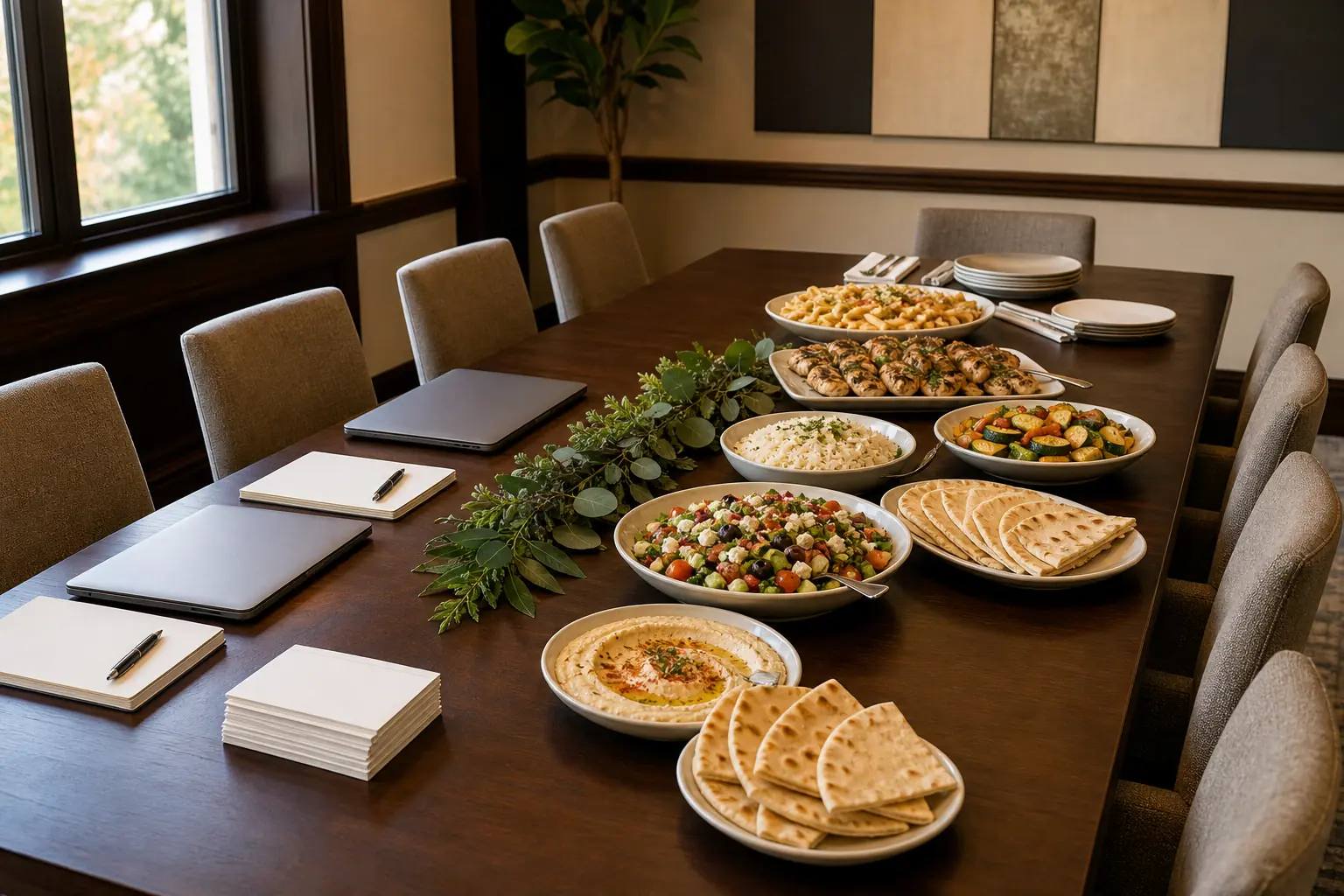
A corporate meal has two agendas whether the organizer writes both down or not.
The official agenda may contain introductions, discussion, decisions, presentations, or recognition. The meal has its own sequence: arrival, ordering or first course, hot food, clearing, payment, and departure.
Problems begin when those agendas collide.
A speaker launches a presentation as entrées arrive. Laptops occupy the space needed for family-style platters. A confidential discussion happens within earshot of other diners. Ten separate checks consume the final block. Half the team leaves before the stated action items.
L.A. Bistro Canton currently lists corporate events among its private-event types. Parties of six or more reserve by phone. Reserving the entire room requires a published minimum of 50 guests and uses family-style package options. Catering offers a third format when an office, training room, or external venue is the better place for the work.
This guide aligns the business agenda with the food agenda before the team sits down.
First decision: is this a meeting with food or a meal with discussion?
The phrase “business lunch” can mean two opposite things.
A meeting with food
The work product is primary. Participants need notebooks, screens, documents, or structured discussion. Food supports the meeting.
This format may fit better in an office or dedicated meeting venue with L.A. Bistro catering, especially when audiovisual equipment, confidential materials, long presentations, or flexible timing are essential.
A meal with discussion
Relationship-building and conversation are primary. The group may review a few topics, welcome a new employee, recognize a milestone, or debrief informally, but eating remains the central activity.
A restaurant table can fit this goal. Close laptops when food arrives, keep formal remarks short, and use the menu as part of the experience.
Decide which event you are planning. Trying to conduct a full workshop inside a normal dining reservation can frustrate both the team and the restaurant.
Format one: regular group dining
L.A. Bistro’s current reservation policy asks parties of six or more to call. For a team dinner, recruiting meal, client lunch, or department gathering that the restaurant can accommodate through normal dining, guests may order individually from the regular menu under the confirmed arrangement.
Regular dining works best when:
- The group wants menu choice
- Conversation can occur at normal restaurant volume
- No privacy guarantee is required
- There is little or no presentation equipment
- The schedule fits normal meal service
- Décor and setup are unnecessary
- Payment can follow the restaurant’s group policy
Do not call a normal table a “private meeting.” Other guests may be nearby, and restaurant staff cannot guarantee confidentiality without a confirmed private arrangement.
Send the menu in advance. Employees and clients can identify likely choices and raise dietary questions before the meeting clock starts.
Format two: entire-room family-style event
The current private-event page states that reserving the entire room requires at least 50 guests. Published packages use family-style service and preselected courses.
This format can suit:
- Company celebrations
- Retirement or recognition events
- Large team gatherings
- Department-wide dinners
- Client appreciation events
- Holiday or annual gatherings
Privacy of the room can support group remarks, but do not infer available technology, acoustics, security, or confidentiality from the phrase “entire room.” Ask about the exact setup and policies.
Review the full package choices and request a current quote. Confirm the minimum, date, event window, room fee, per-person amount, tax, gratuity, deposit, final count, menu, payment, cancellation terms, and every required business document.
Format three: catered meeting at the work site
Catering is often the most efficient option when the agenda needs a true work environment.
It can fit:
- Training sessions
- Planning workshops
- Office lunches
- Board or committee meetings
- Multi-hour presentations
- Events using existing screens, whiteboards, or conference technology
- Groups below the private-room minimum that still need a dedicated room
The advantage is control over the workspace. The tradeoff is operational responsibility.
Clarify ordering notice, quantities, pickup or other logistics, containers, serving utensils, food labels, warming, refrigeration, setup, service, cleanup, and waste. The office organizer or another vendor manages anything not explicitly included.
Keep food away from laptops, confidential papers, and power cables. Create separate work and meal zones if the room allows.
Build the agenda in service blocks
Instead of writing one continuous meeting schedule, build blocks around the meal.
Block 1: arrival and informal connection
Allow people to park, enter, find seats, and greet one another. Do not place the most important announcement in the first five minutes.
For external guests, send the full address—44314 Cherry Hill Road, Canton—and one coordinator’s number. Identify the reservation name.
Block 2: short opening
State the purpose, expected ending, and shape of the meal. Keep this brief enough that ordering or first-course service can proceed.
Block 3: first course and relationship conversation
Use appetizers or salad for introductions, informal updates, or a guided table question. Avoid dense slides while guests are passing food.
Block 4: protected hot-food window
When entrées or family-style platters arrive, pause the formal agenda. Close laptops, move notebooks, and let servers place food safely.
People can still converse. The difference is that no one must choose between listening to a critical decision and eating food at the intended temperature.
Block 5: concise business conclusion
After the main course, summarize decisions, owners, and deadlines. This is more useful than reopening every discussion.
Block 6: payment and departure
Payment should already have an owner and method. End on time, especially when participants have other work obligations.
The two-table-zone rule
Work materials and family-style food need physical space.
If the restaurant approves the layout, think in zones:
- Work zone: closed laptops, notebooks, pens, agenda cards
- Meal zone: platters, serving utensils, plates, and clear server access
Do not place expensive electronics directly beside sauces or shared platters. Keep bags and cables out of aisles.
At a normal restaurant table, the simplest policy is to close and put away laptops before food arrives. Phones can remain available for urgent needs without sitting beside every plate.
For catered office meetings, use a separate buffet surface where possible. This keeps the conference table available for people and documents.
Choose food by meeting goal
Recruiting or client meal
Individual ordering gives guests autonomy. Send the full menu in advance and let dietary needs remain private. Avoid ordering for someone unless they request help.
Team relationship lunch
One shared appetizer can create a common opening, followed by individual entrées. Hommous, salad, or another modest starter encourages passing and conversation without covering the table.
Recognition dinner
Let the honoree choose first. Steak, lamb, seafood, chicken, pasta, or vegetarian food can all feel celebratory when they match the person.
Large company event
Family-style packages simplify service through selected courses. Choose menu contrast and collect dietary needs before final selections.
Working session
Catered trays or individually organized items may be easier than a restaurant table. Choose foods that can be served without interrupting the agenda and maintain safe temperatures.
Build a family-style menu for focus
Current private-event packages include appetizer choices, one salad, two sides, one entrée, and one pasta, with selections varying by level.
Appetizer
Hommous gives the table a shareable Mediterranean start. Higher-package choices may add ravioli, Caprese, chicken, or seafood. Choose a second appetizer only when it creates contrast and fits allergens.
Salad
Mediterranean Salad offers greens, tomato, cucumber, olives, feta, creamy Parmesan vinaigrette, and pesto pita. Caesar offers romaine, dressing, croutons, and Parmesan. Both require specific dietary questions.
Sides
Basmati rice, mashed potatoes, potato wedges, and sautéed vegetables are among current selections. One starch plus vegetables usually creates the broadest plate.
Entrée and pasta
Pair intensity thoughtfully. A creamy entrée plus Alfredo can feel uniform. A spicy entrée plus Diavolo can put heat in two places. A tomato-and-cheese entrée plus Palomino reinforces one flavor family.
There is no universal corporate menu. The goal is predictable service and broad guest comfort, not the organizer’s personal favorite repeated in every course.
Dietary information belongs in a private channel
Do not ask employees to disclose medical or religious information in a public team spreadsheet.
Provide a private way to report:
- Exact allergies
- Cross-contact concerns
- Vegetarian or vegan needs
- Halal requirements
- Dairy, wheat, egg, nuts, sesame, fish, or shellfish concerns
- Other important restrictions
One coordinator can summarize counts and necessary details for the restaurant while limiting unnecessary distribution.
The current regular menu explicitly labels selected vegetarian items and specific halal-certified steak, lamb, and burger products. Those labels belong to exact items and do not automatically apply to chicken, sauces, private-event packages, or catered preparations.
Ask directly and confirm close to the event because menus, suppliers, and procedures can change.
The halal-conscious catering guide provides a detailed framework for off-site orders.
Confidentiality needs an honest risk assessment
A restaurant is a hospitality setting, not automatically a secure conference facility.
For normal dining:
- Assume nearby guests may hear portions of conversation.
- Do not display confidential screens or papers.
- Avoid discussing private employee, legal, medical, customer, or financial information.
- Use the meal for relationship-building and non-sensitive topics.
For an entire-room event, ask about room access and layout but do not assume soundproofing or information-security controls.
For genuinely sensitive work, use a controlled office or professional meeting environment and bring in catered food.
Technology questions must be asked, not imagined
If the event needs a screen, projector, microphone, speakers, outlets, extension cords, internet access, video call, or other equipment, ask what is available and permitted.
The public event information does not promise specific audiovisual services. Do not build the agenda around equipment until the restaurant confirms it.
Bring backups appropriate to the approved plan. Test essential material before guests arrive. Keep cables out of service and accessibility paths.
Often the best restaurant corporate event needs no technology at all: one short welcome, good food, conversation, and a clear closing.
Payment should disappear into the plan
A corporate meal should not end with uncertainty about who has purchasing authority.
Ask in advance about:
- Deposit requirements
- Accepted payment methods
- Separate-check policy for normal dining
- Current gratuity policy
- Room fee, per-person amount, tax, and total for private events
- Catering payment deadline
- Receipts or documentation
- Tax-exempt process, if applicable and accepted
- Cancellation and count-change terms
- Person authorized to approve add-ons
Do not assume invoicing, purchase orders, tax exemption, or post-event billing is available. Confirm each requirement before the event.
Assign one payment owner who can stay until the transaction and receipt are complete.
Protect the ending time
Employees and clients may have childcare, travel, shifts, or another meeting.
State the ending time in the invitation and design backward:
- Payment complete
- Final summary delivered
- Main discussion concluded
- Hot food served and eaten
- Opening completed
- Guests seated
Do not add surprise speeches or a second presentation when the event is already running late.
If the team wants to continue socially, make that optional and separate from the required work event.
The corporate-event phone brief
Prepare this information before calling L.A. Bistro:
- Event purpose
- Preferred date, time, and alternatives
- Guest count and expected range
- Regular dining, entire-room, or catering preference
- Privacy and confidentiality level
- Agenda length and meal-service window
- Dietary summary
- Accessibility needs
- Technology questions
- Menu and service preference
- Payment and documentation requirements
- One authorized coordinator
Ask what current format fits instead of presenting an assumed plan as a requirement.
Align the work with the meal
Use a normal group reservation for a team meal where individual choice and conversation matter. Use an entire-room family-style event when the count meets the current 50-person minimum and a unified celebration is the goal. Use off-site catering when the work requires screens, confidential discussion, long sessions, or a controlled meeting environment.
Then divide the agenda into arrival, opening, first course, protected hot-food window, conclusion, payment, and departure.
The food should support the meeting. The meeting should give the food enough space to be enjoyed.
Review L.A. Bistro Canton’s reservation information, corporate-event options, banquet packages, and catering menu, then call with one agenda designed for both work and hospitality.