
“Family-owned” is one of the most familiar phrases in local dining. It can appear on a sign, at the bottom of a menu, or in the first sentence of an About page. Yet the phrase matters only when diners can feel its meaning in the restaurant itself.
Does the menu have a recognizable point of view? Is there a direct connection between the person leading the kitchen and the food placed on the table? Can a family visit for an ordinary lunch, return for a birthday, and later trust the same restaurant with a graduation or shower? Does the business make decisions for the community it actually serves rather than for a theoretical customer somewhere else?
Those are the questions behind L.A. Bistro Canton’s identity. The restaurant opened in 2018 and is family owned and operated. Souheil Johair is identified as its head chef and owner. Beyond those established facts, the most honest way to describe the family story is through what guests can see: a wide-ranging menu, house-made flavors, familiar dishes given a Bistro interpretation, direct reservation and event planning, and a restaurant built to welcome different generations at one table.
This is not a claim that every independent restaurant works the same way or that local ownership automatically guarantees a perfect meal. It is a closer look at what can make a family-owned restaurant in Canton distinctive—and how those qualities appear at L.A. Bistro on Cherry Hill Road.
The family identity begins with a visible point of view
A restaurant can serve technically good food without expressing much personality. The dishes may follow a proven formula, the room may match a national design package, and the experience may be intentionally identical in every city. Predictability has value, but it is different from identity.
At a chef-led family restaurant, the menu can reveal how the people behind the business think about food. L.A. Bistro does not remain inside one narrow cuisine label. Italian comfort and Mediterranean ingredients form the foundation, while Metro Detroit flavors and house specialties create a third layer.
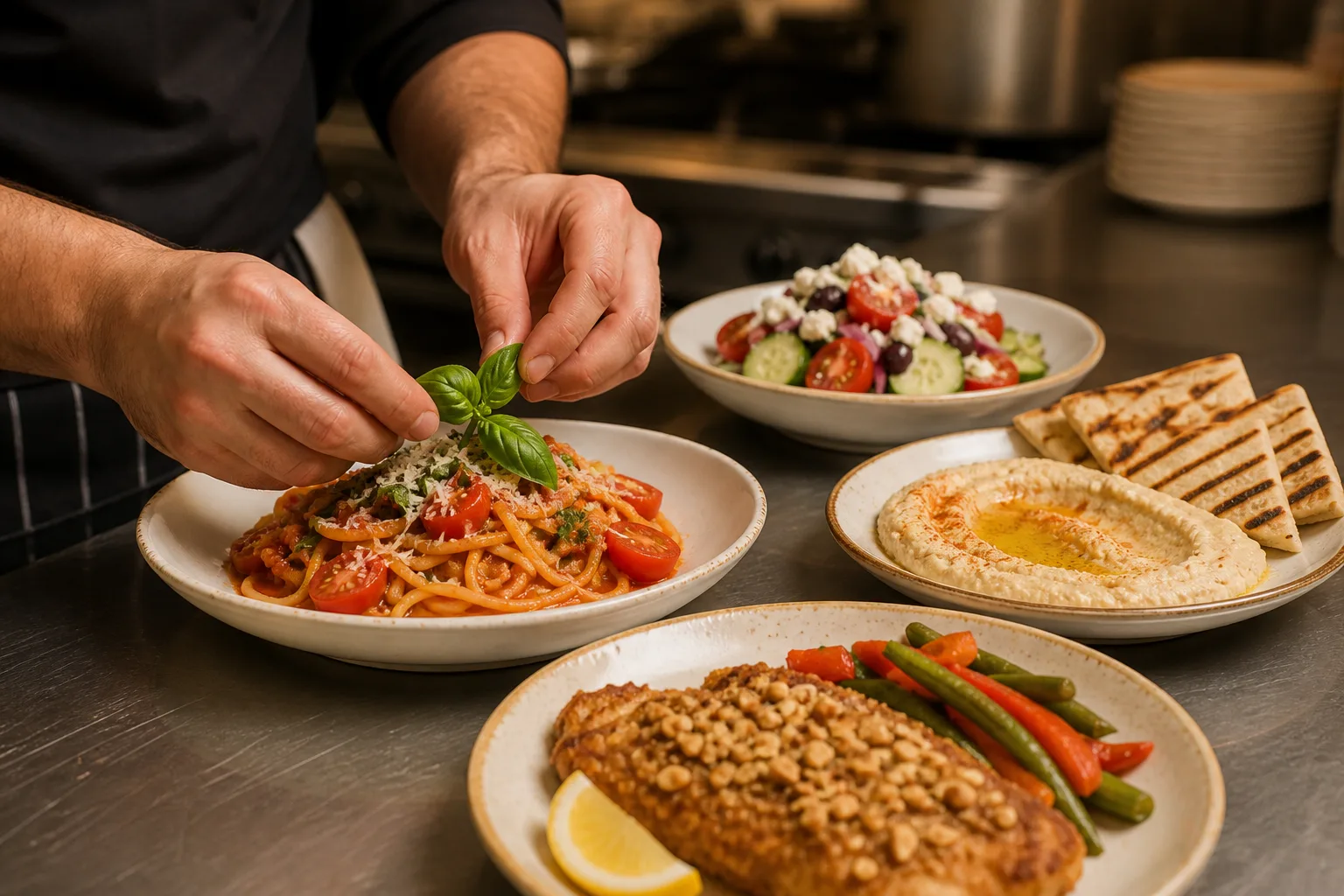
That is how Fettuccine Alfredo can meet zip sauce and Portobello mushrooms. Chicken piccata can arrive with basmati rice, artichokes, sun-dried tomatoes, vegetables, and lemon cream sauce. Almond Chicken can combine a crisp almond coating with rice, vegetables, and the same bright cream finish. Hommous can stay grounded in a family recipe, while Firecracker Shrimp moves toward tangy, sweet heat.
These combinations are not evidence of a menu without direction. They show a restaurant defining its direction around the tastes of its own table. The common thread is generous, recognizable food layered with lemon, garlic, pesto, tomato, cream, herbs, vegetables, rice, pasta, seafood, and carefully chosen proteins.
Guests do not need to know the full history of every recipe to recognize that the menu was assembled by someone making choices rather than checking boxes. That sense of authorship is one of the most meaningful differences a family-owned restaurant can offer.
Chef ownership shortens the distance between idea and plate
L.A. Bistro names Souheil Johair as both head chef and owner. Those two roles do not tell us every detail about daily operations, and it would be wrong to invent a behind-the-scenes story that the restaurant has not published. What the roles do establish is a direct connection between culinary leadership and ownership.
In a large organization, menu decisions can travel through layers of research, purchasing, brand management, testing, and approval. In a chef-owned restaurant, the person responsible for the food is also closely tied to the long-term identity of the business. That can make the menu more personal and more responsive.
The clearest public evidence is in the dish descriptions. Sauces are not treated as generic afterthoughts. The menu identifies house-made marinara, spicy marinara, Alfredo, Palomino, lemon cream, Firecracker sauce, pesto ranch, Bistro sauce, and the zip sauce served with steaks and lamb. Guests can see recurring ingredients used in different forms, creating continuity between categories.
For example, Portobello mushrooms appear in appetizers, pasta, rollups, baguettes, rice bowls, and vegetarian entrées. Sun-dried tomatoes connect chicken, seafood, pasta, and risotto. Basmati rice is not confined to one side of the menu; it supports salads, chicken, seafood, bowls, and vegetarian dishes. This repetition is useful because it feels like a pantry with a point of view rather than unrelated recipes sharing a cover.
If you want to understand the range before visiting, the complete menu is more revealing than a short gallery of best sellers.
A family restaurant should work for different generations
The word “family” can describe ownership, but diners also use it to describe whether a restaurant works for their own household. Those meanings should support each other.
A multigenerational table rarely shares one appetite. Grandparents may prefer a composed chicken or seafood entrée. Parents may be deciding between pasta and steak. Teenagers may want a burger, pizza, Firecracker Chicken, or a hearty rice bowl. A younger child may be most comfortable with grilled chicken, tenders, spaghetti marinara, fettuccine Alfredo, or cheese pizza.
L.A. Bistro’s menu gives those diners separate paths while keeping them in one experience. The adult who orders grilled lamb chops is not eating at a different kind of restaurant from the child with cheese pizza. The vegetarian guest choosing Ravioli Di Portobello or Eggplant Parmesan is not being asked to assemble a meal from potatoes and salad. The seafood diner can choose linguine, salmon, shrimp, or a combination plate without sending the pasta lover somewhere else.
That flexibility is not the same as trying to serve every possible cuisine. The menu remains connected by its ingredients and Bistro style. Variety works because the dishes still feel related.
For families deciding whether the restaurant fits a particular evening, our guide to choosing where to eat dinner in Canton offers a practical checklist for menu range, atmosphere, dietary priorities, reservations, and value.
House recipes create memory
People often return to a local restaurant because of a detail they cannot reproduce by choosing the same category somewhere else. It may be a sauce, a particular combination, or the way several textures arrive on one plate.
At L.A. Bistro, house identity appears most clearly in recurring recipes. The hommous is described as a famous family recipe finished with parsley, paprika, and olive oil. Firecracker sauce is presented as tangy, sweet, and spicy, used with both shrimp and chicken. Palomino sauce gives diners a creamy marinara option that sits between red sauce and Alfredo. Lemon cream sauce connects chicken and seafood dishes without making them identical. Zip sauce ties prime steak and lamb selections to a familiar Metro Detroit steakhouse tradition.
These flavors help guests build personal shorthand. Someone does not need to say, “I want a breaded chicken breast with almond slices, basmati rice, vegetables, sun-dried tomatoes, and lemon cream sauce.” They can say, “I’m getting the Almond Chicken again.” Another guest may come specifically for Firecracker Shrimp or Sami’s Special.
That is how a menu becomes part of a local routine. A named dish carries the memory of the last visit and makes the next visit easier to imagine. National brands are highly skilled at creating this familiarity across thousands of locations. A family-owned restaurant creates it one community and one returning table at a time.
The menu reflects Canton’s real dining needs
Canton is part of a Metro Detroit dining culture shaped by many food traditions and dietary priorities. A local restaurant serves households that may want Italian pasta, Mediterranean flavors, halal-certified meat, vegetarian entrées, seafood, familiar children’s choices, and special-occasion steaks at the same gathering.
L.A. Bistro’s menu responds to that reality. Its Creekstone Farms USDA Prime filet mignon and New York strip are described as halal-certified, as are the grilled USDA Prime lamb chops. The Creekstone Burger is also identified as made with halal-certified premium Angus beef. Because sourcing and preparation details matter, diners with specific halal requirements should still call about the exact dish and current process rather than assuming that one label applies universally.
Vegetarian choices are also designed as full dishes. Portobello Risotto, Ravioli Di Portobello, Eggplant Parmesan, vegetarian pizzas, a Portobello rice bowl, and a lentil-and-bean Veggie Burger give meat-free diners more than one token option. Guests with allergies, vegan requirements, or concerns about cross-contact should speak directly with the restaurant before ordering.
This kind of specificity is important. A local business earns trust by saying what it can support clearly and by making direct conversation possible when a website cannot answer every individual question.
Hospitality extends beyond the dining room
Family restaurants often become useful to a community in stages. A guest first visits for dinner. Later, the same household needs trays for a graduation. Someone plans a bridal shower. A business looks for a place to gather colleagues. Parents arrange a birthday. An anniversary grows from dinner for two into a larger family table.
L.A. Bistro supports those different formats through dine-in service, takeout, catering, private events, and banquet packages. The restaurant lists bridal showers, baby showers, birthdays, corporate events, graduations, and anniversaries among its event types. Current banquet information explains family-style package choices and a minimum of 50 guests for reserving the entire room.
The catering menu translates restaurant favorites into portions designed for groups. It includes trays of Almond Chicken, Chicken Piccata, Firecracker Chicken, Sami’s Special, several pastas, Portobello Risotto, salads, sides, appetizers, rollups, baguettes, and sandwiches. That continuity matters. People considering catering can choose dishes they already know from the restaurant rather than starting over with an unrelated event menu.
Hospitality at this scale is logistical as well as emotional. Clear portions, prices, minimums, and contact information help families plan. Warmth matters, but so does knowing whether a half tray serves the group and whether a private room matches the guest count.
Local accountability is personal
Independent ownership puts praise and criticism closer to home. The business cannot rely on a distant brand identity to absorb every experience. Its name is connected to one address, one community, and the people who return.
That closeness can encourage attention to consistency, but diners should avoid romanticizing it. Family-owned businesses face staffing pressures, busy services, ingredient changes, and ordinary human mistakes like any restaurant. Supporting local does not require pretending every visit will be flawless.
What diners can reasonably expect is a clear way to communicate. Is the phone number easy to find? Does the restaurant publish its current menu, hours, address, reservation policy, and event details? Can a guest ask a direct question before bringing a group? Does the business explain what it offers without hiding behind vague marketing language?
L.A. Bistro publishes its menu and core planning information online and can be reached at (734) 392-7028. Reservations for parties of six or more are handled by phone, which gives the restaurant and guest an opportunity to discuss the table rather than treating a large group as an anonymous time slot.
How to recognize a meaningful family-owned restaurant story
If you are evaluating any family-owned restaurant in Canton, look for evidence beyond the phrase itself.
Start with the people the restaurant publicly names. A founder, chef, or owner gives the story a human anchor. Avoid filling gaps with assumptions; a short accurate story is more credible than a dramatic one without support.
Read the menu for repeated ideas. House sauces, signature dishes, family recipes, and ingredients used thoughtfully across categories indicate a culinary identity. A collection of unrelated trend items may offer variety without telling much of a story.
Notice who can comfortably use the restaurant. Family hospitality should account for different ages, appetites, budgets, and dietary priorities while remaining honest about limits.
Look at how the restaurant participates in milestones. Catering and events reveal whether a business is prepared to serve its community beyond ordinary table service.
Check for direct, current information. Accurate hours, menus, contact details, pricing, reservation policies, and dietary wording show respect for a guest’s planning time.
Visit more than once. The deepest value of a local restaurant is continuity. One meal provides an impression. Returning for a different day, dish, or occasion reveals whether the experience has a dependable center.
A first visit can be simple
You do not need to sample every section of the menu to understand L.A. Bistro in one evening. Choose a short path that combines something familiar with something specific to the restaurant.
One approach is to share hommous and Firecracker Shrimp, then choose one Italian comfort dish and one Bistro favorite. Penne Palomino or Chicken Parmesan can provide the familiar direction; Almond Chicken, Sami’s Special, or Linguine Frutti Di Mare can show how the restaurant combines its influences.
A vegetarian first visit might begin with Caprese or hommous and continue with Portobello Risotto or Ravioli Di Portobello. A celebration might center on halal-certified lamb chops or filet mignon, grilled salmon, or a seafood combination. A relaxed lunch can begin with a rice bowl, salad with protein, rollup, or gourmet baguette.
The goal is not to order the most expensive or most unusual item. It is to find the dish that makes sense for your appetite while leaving enough contrast to understand the menu’s range. Our local guide to Italian and Mediterranean food in Canton can help you compare those directions before visiting.
Frequently asked questions
Is L.A. Bistro Canton family owned?
Yes. L.A. Bistro Canton states that it has been family owned and operated since opening in 2018. Souheil Johair is identified as the restaurant’s head chef and owner.
Where is L.A. Bistro located?
The restaurant is located at 44314 Cherry Hill Road, Canton, Michigan 48187. Current hours and a map are available on the contact page.
Is it a family-friendly restaurant?
The restaurant presents itself as family friendly and offers a broad main menu plus dedicated kids choices such as grilled chicken, chicken tenders, chicken nuggets, spaghetti marinara, fettuccine Alfredo, and cheese pizza. Families with six or more people should call about a reservation.
Does the restaurant handle family celebrations?
Yes. L.A. Bistro offers private events, banquet packages, and catering for occasions including showers, birthdays, graduations, anniversaries, and corporate gatherings. Requirements differ by format, so review the relevant page and call before planning around availability.
What type of food does L.A. Bistro serve?
The menu is built around Italian and Mediterranean influences with chicken, pasta, seafood, halal-certified steak and lamb selections, pizza, rice bowls, vegetarian dishes, handhelds, appetizers, salads, and desserts. House specialties add a distinct Bistro and Metro Detroit point of view.
A family table becomes a community table
The most distinctive family-owned restaurants do not ask diners to admire ownership as an abstract virtue. They turn it into something useful: a menu with personality, direct accountability, flexibility for different guests, and the ability to grow alongside the occasions in a community’s life.
At L.A. Bistro Canton, the public story begins with a clear set of facts—family owned and operated since 2018, led in the kitchen and in ownership by Souheil Johair. The fuller story is visible in family-recipe hommous, recurring house sauces, Italian and Mediterranean combinations, halal-certified steak and lamb choices, vegetarian entrées, children’s meals, catering trays, and rooms prepared for milestones.
That is what makes the restaurant locally distinctive. It is not one gimmick or one oversized claim. It is the connection between chef, menu, table, and Canton.
Read more about the L.A. Bistro story, explore the current menu, or plan a visit to 44314 Cherry Hill Road. A family-owned restaurant becomes part of a city one meal at a time.