
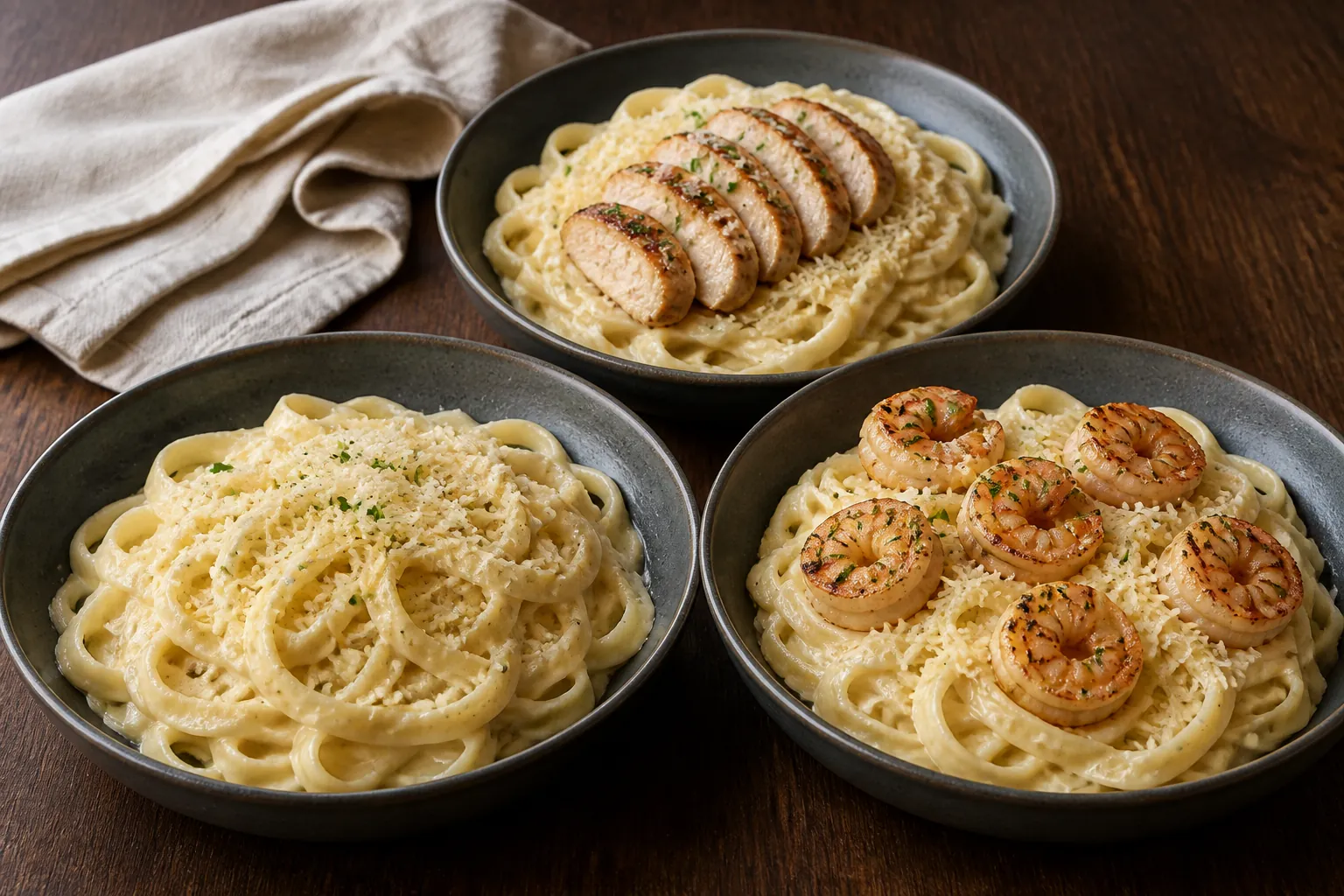
Fettuccine Alfredo has an unusual strength: it can be the simplest dinner on the table or the foundation for one of the most substantial.
At L.A. Bistro Canton, the base entrée is direct—fettuccine tossed in house-made Alfredo sauce and topped with shredded Parmesan. The current pasta menu then opens a set of protein paths: almond or grilled chicken, six shrimp, steak bites, N.Y. strip, filet, or ribeye.
Those are not minor garnishes. Each addition changes the balance of sauce, pasta, texture, appetite, and price. Classic Alfredo keeps attention on ribbons of pasta and a creamy coating. Grilled chicken makes it a familiar protein-and-pasta dinner. Shrimp brings a seafood contrast. Steak can turn the bowl into part of a much larger, richer meal.
For anyone searching for Fettuccine Alfredo in Canton, Michigan, the best order begins by choosing the role you want the pasta to play.
Start with the base bowl
Before adding anything, understand what is already there.
L.A. Bistro’s published description names three central components:
- Fettuccine
- House-made Alfredo sauce
- Shredded Parmesan
Fettuccine is a broad, flat noodle. That width gives a creamy sauce more surface to coat than a thin strand would offer. The noodle and sauce arrive as one integrated texture rather than pasta sitting beneath a separate topping.
Parmesan provides a drier, salty finish over the smoother sauce. It also creates small variations from bite to bite: a forkful from the top may carry more shredded cheese, while pasta from deeper in the bowl holds more of the sauce itself.
The menu does not publish the complete Alfredo recipe. “House-made” tells diners it is prepared as the restaurant’s own sauce, not every dairy component, seasoning, thickener, or preparation detail. That distinction matters when allergies, vegetarian standards, or halal requirements need a precise answer.
Choose the classic bowl with no protein when:
- The creamy pasta itself is the craving
- You plan to share an appetizer first
- You want pasta as the main event, not a side beneath meat
- You prefer a uniform, comforting texture
- You want to taste the house Alfredo before combining it with another strong flavor
Simple does not mean incomplete. It means the sauce-to-noodle relationship stays at the center.
The build-your-bowl map
Every protein pushes Alfredo in a different direction. Use this map before automatically asking, “What should I add?”
Path 1: grilled chicken for balance and familiarity
Grilled chicken is the most straightforward extension of Fettuccine Alfredo. Slices of chicken introduce a firmer bite and savory char against the soft noodles without adding a second sauce or breaded crust.
This route works for diners who want a recognizable full meal: pasta, cream sauce, cheese, and chicken. The flavors do not compete. The chicken gives the fork a protein component while allowing Alfredo to remain dominant.
Order it when you want:
- A familiar chicken Alfredo combination
- Grilled texture rather than breading
- A more protein-centered entrée without moving to steak
- Mild flavors that remain easy to share across different preferences
Do not assume the chicken is halal because some steak and lamb items elsewhere on the menu are explicitly labeled halal-certified. The current pasta add-on wording does not apply that label to grilled chicken. Ask about the exact product and preparation if the distinction matters.
Path 2: almond chicken for crisp, nutty contrast
The almond chicken addition creates a more dramatic change. L.A. Bistro’s separate Almond Chicken entrée is described as chicken breast breaded with thin almond slices and fried. When choosing an almond-chicken pasta add-on, ask how the current add-on is portioned and served rather than assuming it duplicates the full entrée with rice, vegetables, sun-dried tomatoes, and lemon cream.
What makes the idea attractive is contrast: crisp breading and almond texture against creamy noodles.
It also raises more dietary questions. Almond is a tree nut. Breading may involve wheat, egg, dairy, or other ingredients. Frying introduces shared-equipment questions. A diner with a nut allergy should not treat this as an ordinary chicken add-on, and a companion’s order can matter when cross-contact risk is serious.
Choose almond chicken when texture is the priority and everyone at the table can safely accommodate the ingredient and preparation.
For more on the local dish behind that option, read the Detroit-style almond chicken guide for Canton.
Path 3: six shrimp for a seafood Alfredo
Six shrimp turn the bowl toward the sea while preserving the mild, creamy foundation.
Shrimp offers a springier texture and natural sweetness against Alfredo. The current menu gives a count—six—so the addition is easy to understand and, if sharing, easy to divide. One diner can distribute the shrimp through the meal instead of consuming them all at the beginning.
This path suits someone who wants seafood pasta without the three-shellfish mix and sauce choice of Linguine Frutti Di Mare. The Frutti Di Mare guide for Canton compares that dish’s shrimp, scallops, mussels, spicy marinara, and lemon garlic cream in detail.
Choose shrimp Alfredo when:
- You want one seafood rather than a mixed trio
- Cream sauce is more important than tomato or spice
- A clearly counted protein addition helps with portion planning
- You want contrast without the density of steak or breaded chicken
Shrimp is a crustacean allergen. Discuss cross-contact and preparation directly with the restaurant when necessary.
Path 4: steak bites for distribution
Steak bites change how the protein moves through the bowl. Instead of placing one large steak beside or over the fettuccine, smaller pieces can be distributed across more forkfuls.
That creates a sauce-heavy steak-and-pasta experience. Each bite can include noodle, Alfredo, Parmesan, and beef rather than asking the diner to cut a separate steak and combine it manually.
This is the practical steak path when you want beef integrated into the pasta. It can also be easier to share because the pieces are already divided.
The current menu does not attach halal-certified language to the general “steak bites” pasta add-on. Do not transfer certification from named Creekstone steak entrées without confirmation. Ask which cut and product the kitchen currently uses, along with sauce and shared-preparation questions.
Path 5: N.Y. strip for a two-part dinner
A full N.Y. strip changes the role of the Alfredo. The pasta becomes the creamy counterpart to a distinct steak rather than a bowl with protein scattered through it.
The menu separately describes its Creekstone N.Y. Strip entrée as a 14-ounce USDA Prime, halal-certified strip steak, charbroiled and served with zip sauce, mashed potatoes, and vegetables. The pasta add-on list names N.Y. strip, but diners should confirm exactly how the steak is portioned and presented with pasta and whether the same product and certification apply to that specific order.
Choose this direction when the steak should remain recognizable as a steak and the Alfredo should serve as an indulgent companion.
Path 6: filet for tenderness
Filet creates another two-part meal, but with a different steak character. The separate Creekstone Filet Mignon menu listing describes a 10-ounce USDA Prime, halal-certified filet, hand-cut from the heart of the tenderloin.
Tenderness is the reason to consider this route. Alfredo brings creamy richness; filet brings a soft, substantial steak bite without relying on extensive marbling for its identity.
Again, verify the exact pasta-add-on format, product, certification, and plating with the restaurant. A price line naming “filet” is not a complete preparation description.
Path 7: ribeye for maximum richness
Ribeye is the most richness-forward route. Its beef character and fat can stand up to Alfredo rather than disappearing beneath it.
That can be rewarding, but it changes the scale of the meal. Cream sauce, Parmesan, fettuccine, and a full ribeye create several dense elements at once. A salad or vegetable-led opening may make more sense than multiple creamy or fried appetizers.
The separate ribeye entrée has its own description and sides. Ask how the pasta add-on version is served and whether the same steak specifications apply before ordering based on assumptions.
For the broader steak decision, the halal steak guide for Metro Detroit explains the differences among filet, strip, and ribeye while keeping certification questions tied to exact menu items.
A simpler decision: integrated or separate?
The seven paths become easier when divided into two groups.
Integrated additions are easy to carry through the pasta:
- Grilled chicken
- Almond chicken
- Six shrimp
- Steak bites
Separate centerpiece additions make the plate feel like steak plus pasta:
- N.Y. strip
- Filet
- Ribeye
Choose the first group when you want nearly every forkful to combine protein and noodles. Choose the second when cutting and tasting the steak separately is part of dinner.
This is more useful than ranking the proteins from “best” to “worst.” A ribeye is not automatically an upgrade if what you wanted was a cohesive chicken Alfredo bowl. Shrimp is not a compromise if seafood is the flavor you came for. The right addition preserves the role you chose for the pasta.
Three nearby alternatives on the same menu
Sometimes a diner asks for Fettuccine Alfredo because it is the closest familiar phrase to the actual craving. L.A. Bistro’s pasta menu offers alternatives that may fit more precisely.
David Allen Pasta: Alfredo plus vegetables
David Allen Pasta combines penne, house Alfredo, mixed vegetables, and Parmesan. Choose it when you want creamy sauce but also want vegetables built into the pasta rather than ordered separately.
Penne changes the texture, too. Short tubes collect sauce differently from broad fettuccine ribbons. The dish is not simply Fettuccine Alfredo with vegetables added; it has its own pasta-to-sauce pattern.
Zip Sauce Fettuccine Alfredo: a deeper house variation
Zip Sauce Fettuccine Alfredo combines house Alfredo and zip sauces with Portobello mushrooms, then adds Parmesan. It keeps the fettuccine shape while changing the sauce and adding an earthy vegetable.
Choose this when classic Alfredo sounds too uniform and you want a distinctly Detroit-area sauce connection. The Canton guide to Detroit zip sauce explains what to expect without pretending every restaurant uses one fixed recipe.
Penne Palomino: tomato meets cream
Penne Palomino uses a creamy marinara, fresh basil, and Parmesan. It is the bridge for diners who want creaminess but do not want to give up tomato entirely.
Read the Palomino sauce guide for Canton for a full map of the sauce across penne, mushroom ravioli, and catering.
What should come before Alfredo?
Fettuccine Alfredo already supplies pasta, cream sauce, and cheese. The smartest opening usually creates contrast.
The current pasta section offers the option to add a house salad, Caesar salad, or cup of soup. Check the current menu for availability and pricing.
A house salad can introduce crispness and acidity before the creamy main course. A Caesar stays within the Parmesan-forward flavor family but may repeat dairy and richness. Soup depends entirely on the day’s selection and ingredients.
If sharing an appetizer, consider its preparation:
- A fried starter plus almond chicken Alfredo may stack crisp, rich elements.
- A creamy starter plus classic Alfredo may create too little contrast.
- A tomato-led or vegetable-focused appetizer can reset the palate before cream sauce.
- A seafood starter plus shrimp Alfredo repeats shrimp intentionally rather than expanding variety.
There is no rule against a rich meal. The point is to make it deliberate.
Fettuccine Alfredo for families in Canton
Alfredo is often useful at a family table because its base is easy to understand. The kids menu currently includes a Fettuccine Alfredo option, while the full pasta menu provides the adult entrée and protein additions.
That does not mean every child or family member will like the sauce. Creaminess, Parmesan, visible seasoning, portion size, and temperature all affect preference. Ask about the current kids portion and preparation if those details matter.
For mixed-age tables, a practical plan is:
- Let the diner who wants plain Alfredo keep the base uncomplicated.
- Add protein only for the person who wants it.
- Put red-sauce, spicy, or mushroom-heavy dishes elsewhere on the table for variety.
- Confirm allergies across shared dishes, especially dairy, wheat, egg, shellfish, and tree nuts.
The family dinner guide for Canton has a broader method for balancing familiar foods with more adventurous orders.
Dairy, gluten, allergens, and halal questions
The dish name exposes some likely concerns, but it does not answer every question.
Dairy
Alfredo and shredded Parmesan make dairy central. Requesting no Parmesan removes the visible topping, not necessarily dairy in the sauce. Ask about all sauce ingredients and whether a modification is possible.
Wheat and gluten
Standard fettuccine is generally made with wheat, and the current menu does not label this dish gluten-free. Almond chicken adds breading questions. Shared pasta water, cookware, utensils, and prep areas may matter for people with celiac disease or severe sensitivity.
Egg
Pasta or breading may contain egg depending on the products and recipes used. The menu description does not provide that level of detail, so ask directly.
Shellfish and tree nuts
Shrimp introduces a crustacean allergen. Almond chicken introduces a tree nut and potentially shared-fryer concerns. Tell the restaurant the exact allergy and level of sensitivity instead of asking only whether a dish is “safe.”
Halal requirements
Certification must be tied to the exact protein and preparation. Some named steak and lamb entrées on the menu explicitly say halal-certified; the base Fettuccine Alfredo and general pasta-add-on line do not apply that description to every possible combination.
Ask about the precise protein, Alfredo ingredients, Parmesan, cooking process, and shared equipment. If you follow a particular standard, state it. The halal Italian food guide for Canton provides a question list for ordering without relying on broad assumptions.
Menus and suppliers can change. Contact the restaurant before visiting when a restriction is serious and confirm again while ordering.
Takeout: protect the sauce-to-noodle balance
Fettuccine Alfredo changes as it cools. The noodles continue absorbing sauce, dairy thickens, and shredded Parmesan settles into the bowl. A pasta that looked fluid at the restaurant may appear tighter after a drive across Canton or Plymouth.
Protein behaves differently, too. Grilled chicken can dry with excessive reheating. Shrimp can become firm. Almond chicken loses crispness as steam gathers. Steak can move beyond the preferred doneness if reheated aggressively.
For better takeout:
- Pick up near the time you plan to eat.
- Keep the container level.
- Gently turn the pasta through its sauce when you arrive.
- Use short, low-intensity reheating intervals only when needed.
- Avoid repeatedly heating the protein.
- Refrigerate leftovers promptly and follow current food-safety guidance.
For a long drive, ask whether the staff recommends a packing adjustment. Availability varies, but the kitchen knows how its current sauce travels.
The right Canton Alfredo order is the one with a clear job
Choose classic Fettuccine Alfredo when the noodles, house sauce, and Parmesan are the entire point.
Add grilled chicken for a familiar, balanced protein bowl. Choose almond chicken for crisp texture and nutty character after allergy verification. Add six shrimp for a seafood version. Pick steak bites when beef should be distributed through the pasta. Consider N.Y. strip, filet, or ribeye when Alfredo is meant to accompany a distinct steak-centered dinner—and confirm exactly how that addition is served.
Or choose David Allen Pasta, Zip Sauce Fettuccine Alfredo, or Penne Palomino if vegetables, mushrooms, zip sauce, or tomato are closer to the craving than classic Alfredo.
That is the advantage of starting with a simple bowl: every addition has a visible purpose. Review the current pasta menu, decide whether Alfredo should be the main event or the supporting foundation, and find your version at L.A. Bistro on Cherry Hill Road in Canton, Michigan.