
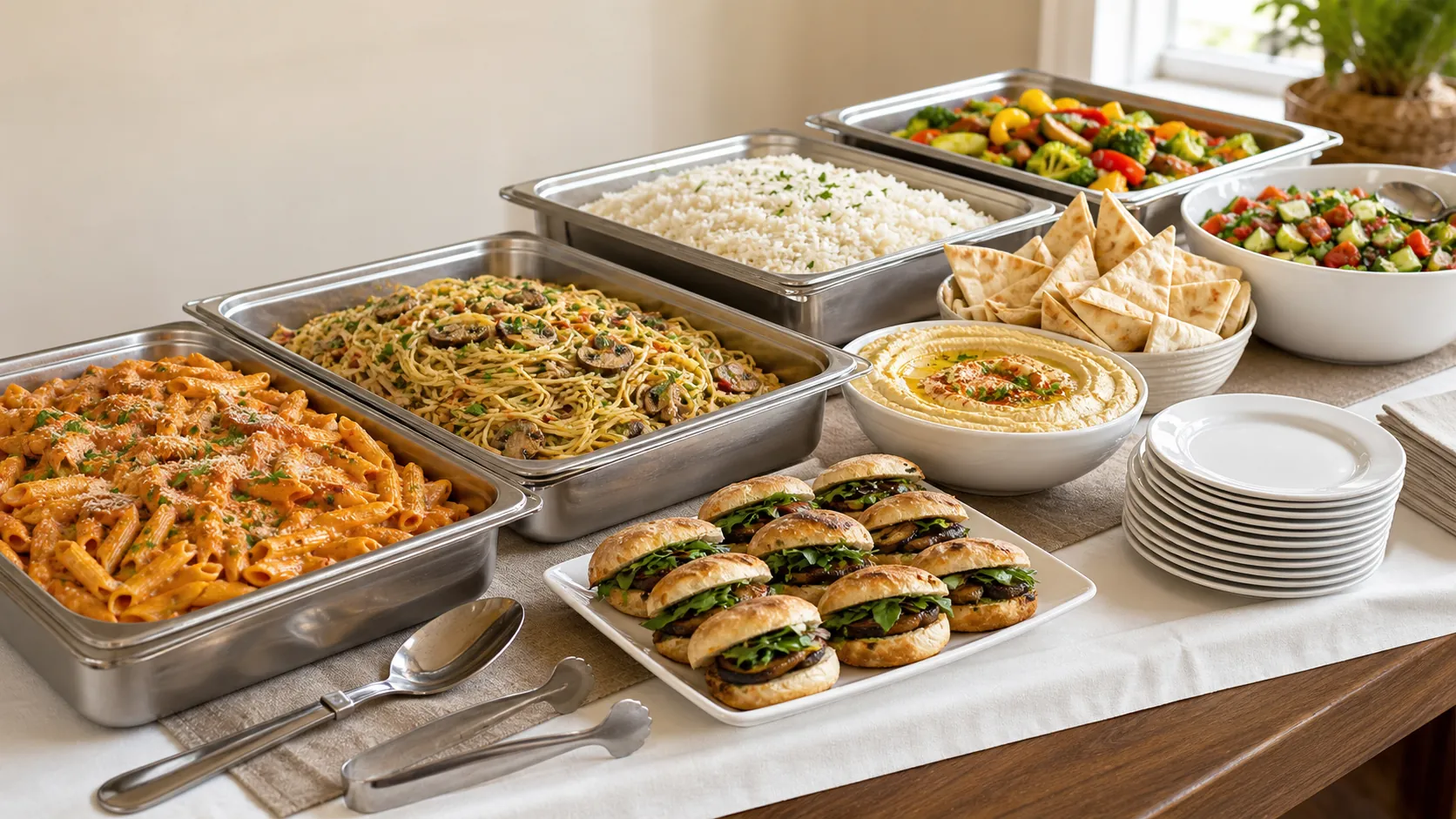
Catering looks like restaurant food multiplied. Planning it is not that simple.
A dining-room order belongs to one person and arrives on one plate. A catering order has to survive transportation, setup, serving utensils, guest traffic, second helpings, dietary labels, temperature changes, and the moment someone moves the wrong spoon into the wrong tray.
For a halal-conscious event in Canton or Plymouth, another layer appears: exactly what is being represented as halal? L.A. Bistro Canton’s current restaurant menu explicitly describes selected filet, N.Y. strip, lamb chops, and burger beef as halal-certified. Its separate catering menu lists trays of chicken, pasta, sides, salads, appetizers, burgers, rollups, and baguettes, but it does not apply a blanket halal label to the catering menu.
That means the planner should not copy a statement from one dining-room item onto an entire tray order. Instead, verify each catered item, ingredient, and preparation detail that matters to the guests. Then calculate quantities and build a service plan that protects those choices after the food leaves the restaurant.
This guide turns that work into six numbers: guests, dietary groups, entrée pieces, side servings, service minutes, and backup portions.
Number one: the actual guest count
Begin with people, not trays.
Create three counts:
- Invited: everyone who received an invitation
- Confirmed: guests who said yes
- Expected: confirmed guests plus a small, realistic allowance for late replies or known uncertainty
Do not order for the invited count when half the list has declined. Do not order exactly for confirmed guests when family events routinely gain two relatives at the last moment. Use evidence from this event and this group.
Separate adults, teenagers, young children, and vendors or staff who also need meals. A photographer, officiant, DJ, speaker, or setup team member may be present during service even if not seated with guests.
Time affects appetite. A noon office lunch, afternoon baby shower, evening graduation, and late-night family gathering do not consume food in the same way. So do preceding activities: guests arriving after a long ceremony may be hungrier than guests who ate at home before an open house.
Write the final planning count at the top of the order. Every later calculation should return to it.
Number two: the dietary map
“We need some halal food” is not a usable catering instruction.
Ask guests privately and group the responses by exact need:
- Guests who require a currently halal-certified meat product
- Guests who also require confirmation of sauces, marinades, stocks, or cheese
- Guests concerned about shared equipment or cross-contact
- Vegetarian guests
- Vegan guests
- Guests with allergies or medically necessary restrictions
- Guests who choose fish or shellfish under their own halal practice
- Guests without restrictions
One guest may belong to several groups. A halal vegetarian with a dairy allergy needs a different solution from a diner who simply prefers pasta.
Do not make one Muslim guest approve food for everyone else. Individuals and families can follow different standards. The planner’s job is to record the instruction accurately and ask the caterer whether it can be supported.
Allergies deserve their own communication. Halal, vegetarian, gluten-free, dairy-free, and nut-free are not interchangeable. A restaurant may be able to describe ingredients without guaranteeing that cross-contact is preventable.
The verification call: connect the catering item to its source
L.A. Bistro’s current catering menu includes a Creekstone Burger tray. The dining-room menu describes the Creekstone Burger beef as halal-certified. The catering listing itself does not repeat that wording, so ask whether the catered burgers use the same exact current halal-certified beef product.
Likewise, the catering menu lists Steak Portobello rollups and baguettes, Spaghetti Bolognese, several chicken trays, and chicken additions. Their catering descriptions do not state that those meats are halal-certified. Do not infer sourcing from the restaurant’s separately labeled filet, strip, lamb, or burger items.
A precise call might sound like:
“I’m considering the catering Creekstone Burger for an event in Plymouth. Does that catered item currently use the same halal-certified beef identified in your dining-room burger description? I also need to verify the bun, cheese, sauce, cooking equipment, and packaging.”
For pasta:
“I’m planning Penne Palomino and Spaghetti Aglio Olio trays for halal-conscious guests. Could you confirm whether either sauce uses meat stock, cooking alcohol, or another ingredient we should review? I also need to know about cheese and shared preparation.”
Call L.A. Bistro at (734) 392-7028. Allow enough lead time for staff to review suppliers and recipes. The halal Italian food guide explains why explicit labels, vegetarian markings, and assumptions need to remain separate.
Number three: entrée pieces and handheld counts
The current catering menu uses different counting systems for different categories.
Main-course trays such as Almond Chicken, Chicken Piccata, Firecracker Chicken, and Sami’s Special are listed as 15 pieces for a half tray and 30 pieces for a full tray. Those are piece counts, not guaranteed guest counts. Whether one or two pieces satisfy a guest depends on piece size, accompanying pasta or sides, appetite, and event timing.
Pasta and risotto appear in the same main-course section with half- and full-tray formats, even though they are not naturally counted as individual pieces. Ask how the restaurant recommends estimating servings for the actual event.
Sandwiches, burgers, rollups, and baguettes use a different format: four for a half tray and eight for a full tray on the current catering menu. Clarify whether those are whole handhelds, how they are cut for service, and whether one unit is intended as an entrée.
This matters for an office lunch. Eight whole baguettes cut into halves can become sixteen smaller portions, but that does not mean sixteen hungry adults have full lunches unless salad, sides, or another entrée support them.
Build a small worksheet by hand:
| Group | Guests | Likely entrée format | Questions |
|---|---|---|---|
| Halal-certified meat required | 12 | Catered burger after verification or a confirmed custom option | Exact meat, preparation, packaging |
| Vegetarian | 6 | Pasta, risotto, veggie burger, Portobello baguette | Dairy, cheese, sauces, shared equipment |
| No restriction | 18 | Mixed trays | Allergens, quantity, variety |
This is not an order recommendation. It is a way to prevent a dietary subgroup from receiving only leftovers after the main buffet line passes.
Number four: side and salad servings
Side dishes use estimated serving ranges rather than pieces.
The current catering menu says a half tray serves roughly 10–12 and a full tray serves roughly 20–25 for rice, mashed potatoes, vegetables, and potato wedges.
Salads follow another range: a half tray serves about 8–10 and a full tray about 25–30 for Mediterranean, Caesar, and Bistro salads.
These ranges assume normal portions within a broader meal. A side tray will not stretch as far if it is the only safe food available for several guests. A salad may stretch farther when there are many entrées, or disappear quickly when the event begins hungry and salad is served first.
Rice and vegetables are useful foundations, but simple appearance does not prove halal, vegan, gluten-free, or allergen-safe preparation. Ask about stock, butter, seasoning, sauces, cheese, dressings, and shared utensils.
For vegetarian guests, a plate of rice and vegetables is not an acceptable “entrée” when others receive composed meals. Include a substantial option such as Portobello Risotto, Spaghetti Aglio Olio after verification, Ravioli or pasta, veggie burgers, or Portobello baguettes according to current availability and the guest’s needs.
Number five: appetizer and per-piece math
The current catering menu lists hommous trays by serving range and several appetizers by the piece.
A half tray of hommous is listed for roughly 10–15 guests and includes 36 pieces of bread. A full tray is listed for roughly 25–30 and includes 60 pieces of bread. Count bread separately when guests are likely to take several pieces or when hommous is one of few options for a dietary group.
Caprese, ravioli, Firecracker Shrimp, and Crispy Firecracker Chicken are priced per piece. Per-piece ordering makes the math visible:
- One piece per guest is a taste
- Two pieces per guest is a more meaningful appetizer portion
- Three or more can begin replacing an entrée, depending on the item
Do not distribute the total evenly in your head when some guests cannot eat the item. Thirty shrimp for thirty attendees provides one each only if every guest eats shrimp and service is controlled. On a self-service buffet, early guests may take two or three.
Use smaller plates and place appetizers away from the main-course utensils. Label ingredients clearly after confirming them. Keep a separate utensil with any item reserved for allergy or religious needs.
Build the menu in layers
A reliable catering menu has four layers.
Layer one: a substantial centerpiece
Choose at least one food that can function as the center of a plate. That might be a confirmed meat item, pasta, risotto, burger, rollup, or baguette. For a mixed group, use two or three distinct centerpieces rather than a dozen overlapping choices.
Layer two: a neutral foundation
Rice, potatoes, or bread help turn portions into meals. Avoid ordering several starches simply because they are affordable. One or two foundations are usually clearer.
Layer three: vegetables or salad
Use sautéed vegetables, Mediterranean salad, Caesar, or Bistro salad to add freshness and color. Review dressings, cheese, croutons, and preparation for each dietary group.
Layer four: an opening bite
Hommous, ravioli, Caprese, or Firecracker items can welcome guests while the main buffet is arranged. If the event begins near meal time, do not leave appetizers out for an extended social hour while hot food cools.
Every layer should have a reason. More trays do not automatically make an event feel more generous; clear choices and enough food do.
Four sample catering frameworks
These examples illustrate structure, not fixed packages or halal certification. Confirm every item and quantity directly.
Canton office lunch
Use two pasta trays with different sauce profiles, a substantial verified handheld or protein option, one salad, vegetables, and hommous. Cut handhelds consistently and label them. Set the buffet just before the scheduled break so staff do not arrive in waves over two hours.
Plymouth graduation open house
Choose foods that tolerate a reasonable service window: pasta, rice, vegetables, salad, hommous, and sturdy handhelds. Replenish smaller pans rather than exposing the full order at once. Count late-arriving relatives in the expected total.
Family baby shower
Use an earlier meal with pasta or risotto, salad, hommous, and a verified protein path. Keep spicy items separate. Ask about cake or dessert service at the venue and coordinate food arrival with games and gifts.
Corporate meeting in Canton
Favor individual or easily portioned formats such as rollups, baguettes, burgers, salad, and sides. Label by exact item and dietary status only after confirmation. Provide a separate serving zone for a medically restricted meal if cross-contact can be managed.
Number six: service minutes
Food can be correctly ordered and still fail because the event timeline is vague.
Work backward from the serving time:
- When can the venue be accessed?
- Who is picking up or receiving the order?
- How long is the drive from 44314 Cherry Hill Road in Canton?
- Where will hot and cold food be held?
- Who supplies serving utensils, plates, napkins, and warming equipment?
- How many minutes are needed to arrange and label the buffet?
- When will guests actually begin eating?
Confirm whether the order is pickup, delivery, drop-off, or staffed service. Do not assume setup, chafing dishes, fuel, linens, serving staff, or cleanup are included. Ask what arrives with the order.
For pickup, use a vehicle with a flat, clean cargo area. Secure trays so they cannot slide. Keep hot food hot and cold food cold, and follow current food-safety guidance for holding and leftovers. If safe temperatures cannot be maintained, shorten the service window or arrange appropriate equipment.
Labeling that helps rather than overpromises
Labels should state what has been confirmed.
Good labels include:
- “Penne Palomino — contains dairy”
- “Vegetarian Portobello sandwiches — confirm vegan status separately”
- “Creekstone Burger — beef source confirmed with restaurant on [date]”
- “Contains nuts” when an allergen is verified
- “Reserved serving utensil — please do not move”
Avoid writing “halal buffet” when only one meat component has been verified. Avoid “allergen-free” unless the caterer can make that guarantee. Avoid “vegan” based only on the absence of visible cheese.
Place cards in front of trays, not on lids that disappear during service. Brief one responsible person on the dietary layout so guests receive consistent answers.
Protect the plan during service
Use one utensil per tray. Position dietary items away from foods likely to create cross-contact. If a guest’s meal is individually packaged, keep it closed and identified until that person receives it.
Let guests with serious restrictions serve first when appropriate, or hold their portions separately. This is not special treatment; it prevents the only suitable item from disappearing or being contaminated.
Refill from backup containers instead of piling food into overfilled trays. Remove empty or temperature-compromised food promptly. Do not mix fresh food into a pan that has been sitting out without checking safe handling.
Assign cleanup and leftover responsibility before the event. Bring food-storage containers if the venue permits leftovers, and label them with the date. Guests should not take food that has been held unsafely simply to avoid waste.
Frequently asked questions
Does L.A. Bistro offer halal catering in Canton and Plymouth?
L.A. Bistro’s restaurant menu explicitly labels selected meats halal-certified, while the catering menu does not carry a blanket halal designation. Ask whether the exact catered item uses a currently halal-certified product and verify preparation, sauces, sides, packaging, and cross-contact according to your needs.
Is the catered Creekstone Burger halal-certified?
The dining-room Creekstone Burger description identifies its beef as halal-certified; the catering listing does not repeat that wording. Confirm that the catered burger uses the same current product before representing it to guests.
Are the chicken catering trays halal?
The current catering descriptions for chicken items do not state halal-certified sourcing. This guide does not label them halal. Ask the restaurant about the exact product.
Are vegetarian catering items automatically halal?
No. Sauces, cheese, stock, alcohol-derived ingredients, and shared preparation may matter. Vegetarian and halal labels answer different questions.
How much does a tray serve?
It depends on the category. Current side trays list approximately 10–12 servings for a half and 20–25 for a full. Salads list about 8–10 and 25–30. Main-course chicken trays use 15- and 30-piece counts. Confirm pasta, risotto, and handheld quantities for the actual event.
How early should I order?
Contact the restaurant as soon as the date, count, and basic menu are known, especially for a large event or detailed dietary verification. Ask about current lead times rather than relying on a general rule.
Where can I see the catering options?
Review the current L.A. Bistro catering menu and call (734) 392-7028 for availability, quantities, service format, and dietary questions.
A successful buffet is a chain of accurate handoffs
Halal-conscious catering in Canton or Plymouth is not proven by placing one labeled meat beside several unreviewed trays. It is built through accurate handoffs: guest to planner, planner to restaurant, restaurant to pickup or delivery, and buffet setup to final service.
Start with the real guest count. Record dietary needs precisely. Verify the exact catering items without transferring claims from unrelated menu descriptions. Match tray formats to appetite, protect the food through transport, and label only what has been confirmed.
Use the catering menu to identify likely dishes, then contact L.A. Bistro Canton with the event date, location, guest count, and questions. When the math and communication are sound, the buffet can do what it was meant to do: feed people without turning the host into a full-time troubleshooter.