
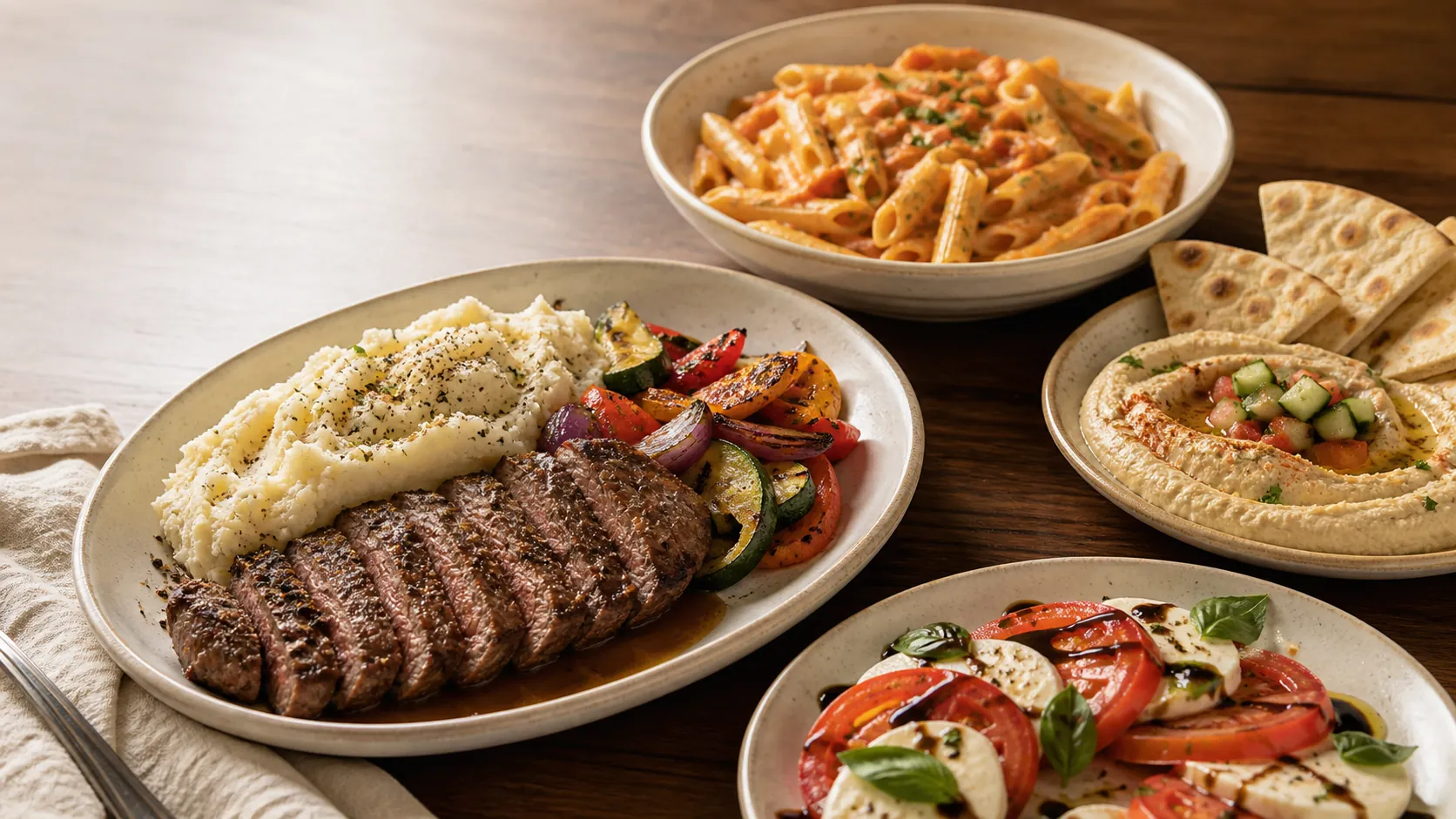
Searching for halal Italian food in Canton can lead to a surprisingly complicated question: what, exactly, is being described as halal?
It may be the source of a steak. It may be an entire composed dish, including its sauce and sides. It may refer to a kitchen’s preparation practices. Or it may be an informal label applied to a restaurant simply because one protein is halal-certified. Those meanings are not interchangeable.
That distinction matters at an Italian and Mediterranean restaurant, where a plate can combine meat, pasta, cheese, stock, sauce, bread, and garnishes. A diner who follows halal guidelines may care about every component, as well as shared equipment or cross-contact. Another diner may be primarily concerned with the meat source. A useful local dining guide should help both people ask better questions without making promises the menu does not make.
At L.A. Bistro Canton, the current menu explicitly describes several individual beef and lamb selections as halal-certified. Other dishes—including many pastas, chicken entrées, seafood choices, sauces, and vegetarian items—do not carry that same wording. This guide draws a clear line between those categories and explains how to confirm the details that matter to you before visiting.
Begin with a three-part confidence map
Instead of asking whether an entire cuisine is halal, divide the menu into three circles.
Circle one: items explicitly labeled halal-certified
These are the easiest starting points because the current restaurant menu makes a direct statement about a named meat item. At the time of writing, that group includes:
- The Creekstone Filet Mignon, described as a 10-ounce Creekstone Farms USDA Prime, halal-certified filet
- The Creekstone N.Y. Strip, described as a 14-ounce Creekstone Farms USDA Prime, halal-certified strip steak
- The Grilled Lamb Chops, described as USDA Prime, halal-certified lamb chops
- The Creekstone Burger, described as all-natural, halal-certified Creekstone Farms premium Angus beef
- The lamb chops included with the Salmon, Shrimp and Lamb Combo, which are specifically identified as halal-certified
Those descriptions provide a concrete place to begin. They do not automatically answer every question about the complete plate. The steak entrées come with zip sauce, mashed potatoes, and vegetables; the burger includes cheese, Bistro sauce, and a brioche bun. A diner who needs ingredient-level confirmation should still ask about those accompanying components.
Circle two: dishes that may be workable after a conversation
Many Italian and Mediterranean choices are built from ingredients that appear simple: pasta, tomato sauce, vegetables, cheese, rice, bread, olive oil, seafood, or dairy. Appearance is not verification. Stocks, flavorings, extracts, cheeses, dressings, marinades, and cooking methods can introduce questions that are invisible on the plate.
This second circle can include pasta, vegetarian dishes, salads, appetizers, seafood, sides, and certain combinations. The right question is not, “Does this look halal?” It is, “Can the restaurant confirm the ingredients and preparation details that matter to me today?”
Circle three: items without enough information to assume
If a menu description names meat but does not label that meat halal-certified, do not generalize from another item. The current menu’s halal wording for a Creekstone filet, strip steak, lamb chops, and burger does not prove that every beef, chicken, or meat-sauce item follows the same sourcing.
For example, the Ribeye description does not include the words halal-certified. Neither do the chicken entrées or Bolognese description. That does not establish that they are unsuitable; it means the published menu alone does not provide enough information for this guide to make the claim. Ask before ordering.
The clearest halal-labeled steak choices in Canton
For a diner whose main priority is a halal-certified meat selection in a sit-down setting, the filet, N.Y. strip, and lamb chops are the clearest current menu entries.
The Creekstone Filet Mignon is positioned as the tender, special-occasion choice. It is hand-cut from the heart of the tenderloin, charbroiled, and presented with mashed potatoes, sautéed vegetables, and zip sauce. Because filet is naturally leaner and prized for tenderness, it suits a diner who prefers a refined steak experience over a very large cut.
The Creekstone N.Y. Strip is a 14-ounce steak with the firmer bite and beef-forward character associated with the cut. It receives the same basic plated treatment: charbroiling, zip sauce, mashed potatoes, and vegetables. It may appeal to someone who wants a more substantial steak while retaining an explicitly halal-certified menu description.
The Grilled Lamb Chops bring a Mediterranean direction to the steakhouse-style plate. The menu lists three marinated, charbroiled chops with mashed potatoes, vegetables, and zip sauce, with additional chops available. Lamb is especially useful for a mixed-preference table because it connects naturally with hommous, rice, grilled vegetables, and other Mediterranean flavors while still feeling appropriate for a celebration dinner.
Read these as current menu descriptions, not permanent guarantees. Suppliers, recipes, and availability can change. If halal compliance determines whether you can eat the meal, confirm the current meat source and the rest of the plate directly with the restaurant when reserving or ordering.
An everyday option: the halal-labeled Creekstone Burger
Halal dining should not have to mean reserving steak for a milestone. The Creekstone Burger gives Canton diners a more casual option at lunch or dinner.
Its current description identifies the beef as halal-certified Creekstone Farms premium Angus. The burger also includes American cheese, shredded Romaine, tomato, pickles, Bistro sauce, and a brioche bun, with a choice of rice or potato wedges under the handheld menu policy.
This is a good example of why ingredient-level questions still matter. A halal label attached to the beef addresses the patty’s stated sourcing. It does not, by itself, describe every ingredient in the sauce, bun, cheese, cooking surface, or side. Some diners will be comfortable ordering from that information. Others will want to ask about shared grills, utensils, and condiments. Neither approach should be assumed for someone else.
If taking the burger home, use the restaurant’s online ordering option and call first if the digital ordering flow does not provide enough space for a dietary question. A note attached to an order is not always a substitute for a real-time conversation.
Why pasta needs its own verification questions
Italian food is often imagined as a safe combination of noodles, tomatoes, herbs, olive oil, and cheese. Some recipes are that direct. Others contain ingredients a diner would never identify by sight.
L.A. Bistro’s pasta menu includes Spaghetti Aglio Olio, Spaghetti Bolognese, David Allen Pasta, Diavolo Pasta, Fettuccine Alfredo, Penne Palomino, and Zip Sauce Fettuccine Alfredo. The sauces move from olive-oil-and-garlic to marinara, meat sauce, cream sauce, and a cream-and-tomato blend.
For a halal diner, useful pasta questions can include:
- Does this sauce contain any cooking wine, spirits, or alcohol-derived flavoring?
- Is meat used in the sauce, stock, or garnish, and what is its current source?
- Does the cheese use animal-derived enzymes, and is that relevant to the standard I follow?
- Can the pasta be prepared without a particular sauce or garnish?
- Are utensils, pans, or cooking surfaces shared in a way I need to consider?
- If I add steak, which specific cut or portion is used, and is that exact add-on currently halal-certified?
The menu lists steak bites, an N.Y. strip, filet, and ribeye among possible pasta additions. Do not assume that the words “steak add-on” identify the same product as the separately listed halal-certified steak entrée. Ask which meat is actually used for the order.
One practical approach is to choose the pasta you want first, then verify it as a complete dish. A diner might be interested in vegetarian-marked Spaghetti Aglio Olio, tomato-forward Diavolo Pasta, creamy Fettuccine Alfredo, or Penne Palomino. The vegetarian badge is useful for identifying the absence of meat as defined by the menu, but “vegetarian” and “halal” answer different questions. Verification is still the bridge between the label and your own requirements.
Vegetarian and seafood do not automatically mean halal
This is one of the most common shortcuts in restaurant planning: when meat sourcing is uncertain, order seafood or something vegetarian and call the problem solved.
That may work for an individual diner after reviewing the dish, but it should not be treated as a universal rule. A vegetarian entrée can contain cheese, cream, dressing, pesto, or flavorings that a diner wants to examine. A seafood plate can include sauce, stock, breading, or shared frying oil. Even a salad can involve dressing ingredients, cheese, croutons, or a protein prepared on shared equipment.
At L.A. Bistro, vegetarian-marked possibilities include Spaghetti Aglio Olio, Margherita Pizza, Cheese Pizza, Veggie Pizza, Portobello Risotto, Ravioli Di Portobello, Eggplant Parmesan, and the Vegetarian Portobello Rice Bowl. These provide valuable non-meat directions for the conversation. They are not labeled halal-certified on the current menu.
Seafood choices range from Linguine Frutti Di Mare and Salmon Al-Bianca to Shrimp Al-Bianca and Firecracker Shrimp. Some are grilled, some fried, and some served with cream sauce or marinara. Diners also differ in which seafood they eat under their own interpretation and practice. Ask about both the species and preparation rather than treating “seafood” as a complete dietary answer.
Five details worth confirming before you order
A long, vague question can be difficult for a host or server to answer accurately. A short checklist is easier.
1. The exact protein
Name the dish and cut. “Is your meat halal?” is broader than “Is the beef patty used in the Creekstone Burger currently halal-certified?” The second question reduces ambiguity.
2. The sauce and marinade
Italian cooking sometimes uses wine, spirits, stock, extracts, or compound flavorings. The fact that alcohol may be cooked does not resolve the question for every halal diner. Ask whether the specific sauce or marinade contains an ingredient you avoid.
At L.A. Bistro, several dishes mention red wine in their published descriptions, including the Portobello appetizer and Caprese dressing. That wording is a visible reason to verify rather than assume. Other recipes may require questions even when the short menu description does not list every component.
3. Cheese and other derived ingredients
Parmesan, mozzarella, feta, cream sauces, dressings, and pesto appear throughout the menu. If enzyme source, gelatin, emulsifiers, or other derived ingredients matter to you, say so specifically. Restaurant staff cannot infer the standard behind the word “halal” unless you explain what you need confirmed.
4. Shared equipment and cross-contact
Ask about the grill, fryer, pans, utensils, and preparation surfaces if separation is important to you. Cross-contact practices are distinct from meat certification. A restaurant can accurately label a purchased meat product halal-certified without representing that its entire kitchen is exclusively halal.
5. Current availability
Menus describe a point in time. An item can sell out, a supplier can change, or a substitution can be proposed. Confirm important details on the day of the visit, particularly for a celebration, group meal, or guest with firm religious requirements.
A simple phone script that gets a useful answer
Calling a restaurant should not feel like an interrogation. State the dish, the concern, and the level of detail needed.
Try this:
“I’m planning to order the Creekstone N.Y. Strip. Your current menu describes that cut as halal-certified. Could you confirm that the meat being served now is the same, and tell me whether the zip sauce or preparation uses alcohol? I also need to know about shared grill contact.”
For pasta:
“I’m interested in the Penne Palomino. I follow halal dietary guidelines and avoid alcohol in sauces. Could someone confirm the sauce ingredients and whether any meat stock or alcohol is used?”
The question does not need to include your life story. It does need to be specific enough that the employee knows whether to check a package, recipe, supplier record, or kitchen procedure. If the person answering the phone does not know, politely ask when someone who can verify will be available.
You can reach L.A. Bistro Canton at (734) 392-7028 or use the contact page before an important visit.
How to build an Italian and Mediterranean meal after verification
Once the necessary details are confirmed, the menu allows several different experiences rather than one fixed “halal meal.”
The steak dinner
Begin with the halal-labeled filet or N.Y. strip and verify the sauce, sides, and preparation. If the table wants a shared appetizer, discuss hommous or another choice separately rather than assuming the entrée confirmation covers the whole order.
The Mediterranean-leaning dinner
Start with the halal-labeled lamb chops. Ask about the marinade and zip sauce, then consider hommous, salad, rice, or vegetables after checking their ingredients. The result can emphasize charbroiled meat, olive oil, vegetables, bread, and bright Mediterranean flavors.
The Italian pasta dinner
Choose a pasta for its actual flavor profile—garlic and olive oil, tomato, spicy marinara, Alfredo, or Palomino—then verify its sauce and any protein addition. This prevents a dietary search from flattening every Italian dish into the same choice.
The casual burger meal
Confirm the Creekstone Burger components that matter to you and choose rice or potato wedges. It is a practical option for lunch, a weekday dinner, or a mixed group in which not everyone wants a plated steak.
The mixed-preference table
Some guests may want halal-certified meat, while others want vegetarian pasta, pizza, seafood, or chicken. L.A. Bistro’s broad menu can make the table easier to organize, but each dietary order should be handled on its own facts. Our family dinner guide and large-group dining guide offer additional planning ideas.
Planning a halal-conscious group dinner in Canton
Group meals raise the stakes because one organizer may be speaking for several guests with different levels of observance.
Do not ask one person to declare what “all Muslims eat.” Collect requirements privately and distinguish preferences from non-negotiable needs. One guest may require certified meat and separation from non-halal food. Another may choose seafood after reviewing a sauce. A third may need vegetarian food without alcohol-derived ingredients. Those are individual instructions, not contradictions.
Call before the event with a concise list. Ask whether the restaurant can accommodate the requested preparation and whether the exact items will be available. For parties of six or more, L.A. Bistro asks guests to reserve by phone; the reservation page explains the policy.
When ordering for the table, avoid shared platters unless everyone is comfortable with every component and serving utensil. Individual plates can make boundaries clearer. If someone’s meal needs special handling, confirm it again when ordering and let that guest identify the plate when it arrives.
For catered gatherings, the same principle applies. A tray’s name is not a complete ingredient statement. Discuss meat sourcing, sauces, dressings, preparation, labels, and serving utensils with the restaurant before choosing from the catering menu.
Local convenience for Canton and nearby communities
L.A. Bistro is at 44314 Cherry Hill Road in Canton, making it a practical meeting point for diners coming from Canton neighborhoods and nearby Plymouth, Westland, Livonia, and other western Metro Detroit communities.
Location matters when dietary questions require advance coordination. A nearby restaurant is easier to call, visit, and revisit than a destination chosen only from a search result. It also allows local diners to learn which questions produce clear answers and which dishes fit their personal standard.
The restaurant opens at 11 a.m. daily according to its posted hours, so the halal-labeled burger can fit lunch while the filet, strip, or lamb chops can anchor dinner. Check the current menu and posted contact information before traveling, especially on holidays or for a large party.
Frequently asked questions
Is L.A. Bistro Canton a fully halal restaurant?
This guide does not make that claim. The current menu explicitly labels certain Creekstone beef items and lamb chops halal-certified. Other menu items and the kitchen as a whole are not described here as certified halal. Ask the restaurant about the exact dish and preparation practices important to you.
Which meats are labeled halal-certified on the current menu?
The Creekstone Filet Mignon, Creekstone N.Y. Strip, Grilled Lamb Chops, Creekstone Burger beef, and the lamb chops in the Salmon, Shrimp and Lamb Combo are explicitly described as halal-certified. Confirm current sourcing when ordering because restaurant supplies can change.
Is the ribeye halal-certified?
The current ribeye description does not use the words halal-certified, so this guide does not label it that way. Contact the restaurant for current sourcing information.
Is the chicken halal?
The current chicken-item descriptions do not identify the chicken as halal-certified. Ask the restaurant rather than inferring from the halal label attached to certain beef and lamb items.
Are the pasta dishes halal?
The menu does not apply a general halal label to the pasta category. Ask about sauce ingredients, alcohol, stock, cheese, preparation, and the source of any added meat. Vegetarian labeling does not automatically answer halal questions.
Can the restaurant accommodate a halal-conscious birthday or family dinner?
The menu provides explicitly halal-labeled meat starting points and many other choices that guests can discuss with the restaurant. Call ahead to explain the group’s exact requirements, confirm current sourcing and preparation, and reserve by phone for six or more people.
Does the restaurant serve takeout?
Yes. Online ordering is available, but a phone conversation is better when a dietary requirement needs confirmation beyond the options shown in the ordering interface.
The most reliable answer is specific, current, and personal
Finding halal Italian food in Canton is not about discovering one magic label that applies to every plate. It is about connecting an explicit menu statement with the exact meal you plan to eat.
At L.A. Bistro Canton, the halal-certified descriptions attached to selected filet, strip steak, lamb, and burger items give diners a meaningful starting point. Pasta, sauces, cheese, seafood, vegetarian food, sides, and kitchen practices still deserve their own questions when those details matter to you.
Review the full L.A. Bistro menu, identify the dish you actually want, and call (734) 392-7028 with a short checklist. That approach respects both the diner’s religious practice and the difference between what a menu explicitly states and what no restaurant guide should assume.