
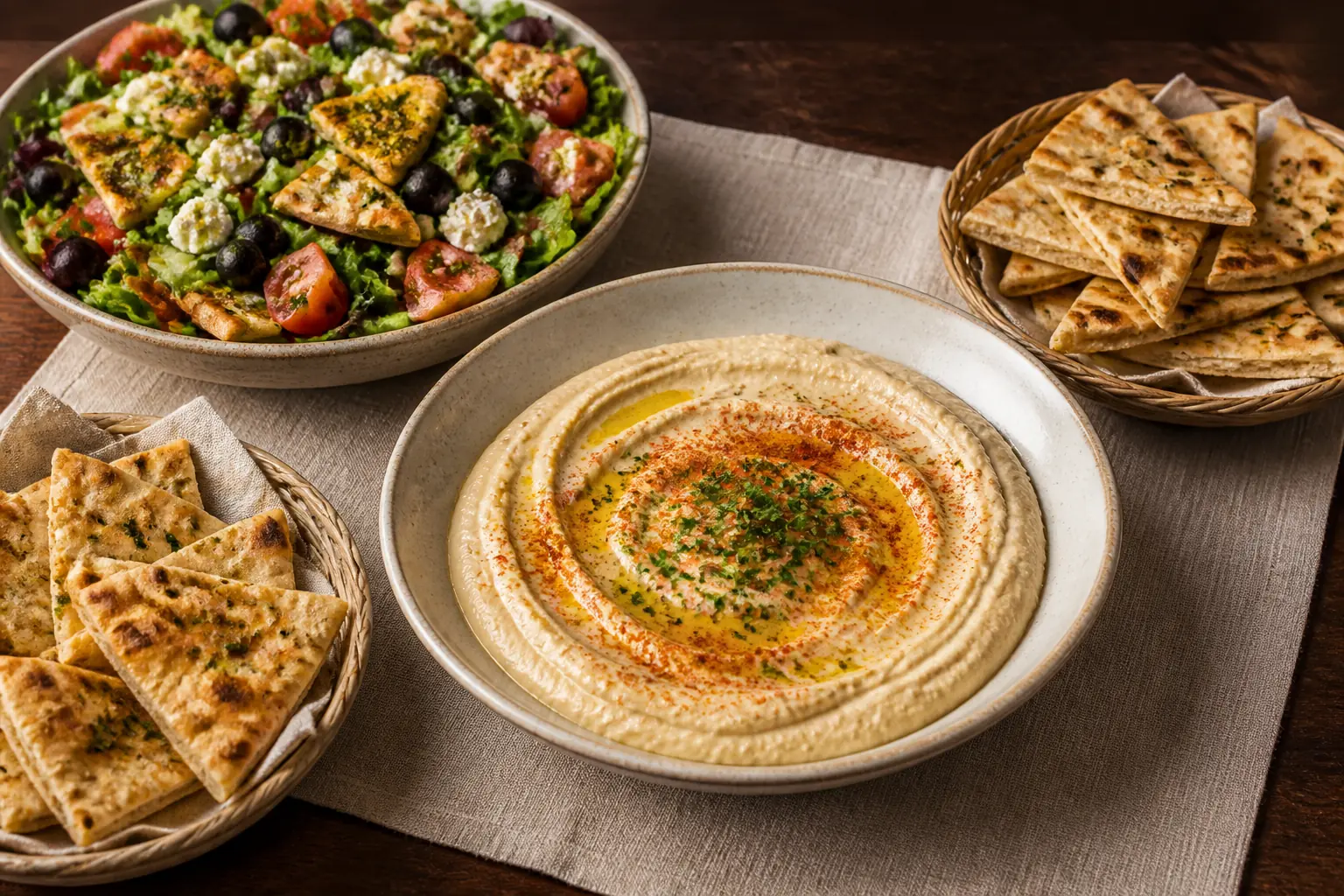
A Mediterranean table can begin with three simple shapes: a bowl of hommous in the center, a salad beside it, and warm pita within everyone’s reach.
The ingredients are familiar. The planning is where tables often go wrong.
Too little pita leaves hommous behind. Too much bread dulls the appetite before the entrées arrive. A creamy salad dressing can repeat the richness of later courses. One small spread works for two people but becomes ceremonial at a table of six.
L.A. Bistro Canton gives diners several ways to solve that puzzle. Its current menu offers a small or large Hommous made from a family recipe and topped with parsley, paprika, and olive oil. The salads take three different directions. The side menu includes a six-piece basket of Father Sam’s mini pitas and a separate grilled pesto pita.
This guide builds the order from the center out: spread first, greens second, bread third, then portions, dietary questions, and the entrée that follows.
The center: L.A. Bistro’s family-recipe Hommous
L.A. Bistro spells the dish Hommous on its menu, though many Canton diners search for “hummus.” The spelling changes; the role at the table does not.
The current description is concise: the restaurant’s famous family recipe topped with parsley, paprika, and olive oil. It is offered in small and large sizes.
That topping plan creates three visible flavor zones. Olive oil gives the surface gloss and richness. Paprika adds color and seasoning. Parsley brings freshness. A scoop from the center may taste different from one drawn through all three toppings.
Before stirring everything together, taste the spread as plated. Then decide whether to blend the toppings across the surface or keep them more distinct.
Hommous can serve several roles:
- A shared appetizer before pasta, steak, chicken, seafood, or lamb
- The creamy center of a salad-and-pita lunch
- A familiar option for a mixed-age family table
- A Mediterranean counterpoint to an Italian entrée
- One part of a vegetarian order after ingredient verification
Do not confuse plain Hommous with Hommous with Steak, a separate item topped with beef tenderloin, mushrooms, green pepper, and onion. When dietary boundaries matter, order by the complete item name.
The second ring: choose the right salad direction
L.A. Bistro’s three main salads are not interchangeable bowls of greens. Each creates a different bridge from hommous to the rest of dinner.
Mediterranean Salad: the fullest thematic match
The current Mediterranean Salad combines artisan greens, romaine, and iceberg with Roma tomatoes, cucumber, olives, feta, creamy Parmesan vinaigrette, and grilled pesto pita.
This is the natural companion when the table wants the strongest Mediterranean direction. Tomato and cucumber bring freshness. Olives and feta add salty accents. Three kinds of greens create varied texture. Grilled pesto pita connects the salad back to the bread portion of the meal.
The dressing and toppings also make it more substantial than plain greens. Creamy Parmesan vinaigrette and feta introduce dairy. Pesto pita can add wheat, dairy, nuts, or other ingredients depending on the current recipes. Ask when those distinctions matter.
Because pita already appears in the salad, count it before ordering a large bread basket. The pieces mixed with greens are not the same experience as plain mini pitas for dipping, but they still contribute to the total bread on the table.
L.A. Bistro Salad: rice changes the rhythm
The L.A. Bistro Salad uses shredded iceberg, Roma tomatoes, cucumbers, baby spinach, and basmati rice in creamy Parmesan vinaigrette.
Rice makes this the most unusual pairing with hommous. Instead of feta, olives, or croutons, the salad brings a soft grain into the greens. That can turn salad and hommous into a more complete lunch-style combination.
Choose this route when:
- Basmati rice sounds better than pesto pita in the salad
- You want a cool bowl with both greens and grain
- The entrée will not already include a large rice portion
- A house-specific preparation matters more than a familiar Mediterranean salad format
The creamy Parmesan vinaigrette still requires dairy and ingredient verification. The current description does not apply a Vegetarian badge, so strict vegetarian diners should ask rather than infer from the absence of meat in the short text.
Caesar Salad: the Italian bridge
Caesar Salad combines romaine, Caesar dressing, croutons, and shredded Parmesan.
This is the bridge when hommous will be followed by Italian pasta, pizza, or Chicken Parmesan. Its crisp romaine and croutons contrast with the smooth spread, while Parmesan connects to later Italian flavors.
Caesar dressing can contain fish-derived ingredients, egg, dairy, or other allergens depending on the recipe. Do not assume the base salad is vegetarian without asking. Croutons introduce wheat and gluten concerns.
The outer ring: calculate the pita
The current side menu gives diners two clearly described bread paths.
Bread Basket: six mini pitas
The Bread Basket includes six fresh Father Sam’s mini pitas served with warm butter.
Six pieces make portion planning visible:
- Two diners can begin with three each.
- Three diners can begin with two each.
- Six diners can begin with one each.
That arithmetic does not account for appetite, size, or whether the pitas will be split, but it prevents the table from ordering blindly.
Warm butter introduces dairy. The pita itself raises wheat and gluten questions and may contain other ingredients requiring verification.
Grilled Pesto Pita: one flavored bread direction
The Grilled Pesto Pita is brushed with house pesto sauce and grilled.
Choose it when the bread should contribute its own herb and char character. Plain mini pitas keep the focus on hommous; pesto pita makes bread a stronger flavor.
The tradeoff is repetition. The Mediterranean Salad already includes grilled pesto pita. Adding more can be perfect for pesto lovers, but it does not expand variety.
Pesto recipes may include dairy or tree nuts. Ask about the current sauce rather than relying on a standard recipe from elsewhere.
The center-out formula for two diners
For two people planning full entrées afterward, begin conservatively:
- Choose a small Hommous.
- Select one salad to share or individual side salads if preferred.
- Add one bread basket only if pita is not otherwise included in sufficient quantity.
- Pause before ordering another appetizer.
This gives each person several hommous-and-pita bites plus cool greens without turning the first course into a full meal.
If the goal is a light lunch rather than an opening course, a larger Hommous, one salad, and pita can become the meal after ingredient verification. Appetite and portion expectations vary, so ask the restaurant about current serving size when that determines the order.
The center-out formula for four diners
Four people need enough food to share meaningfully, but not necessarily four of everything.
A practical start is:
- One large Hommous
- One or two salads depending on whether everyone wants greens
- One six-piece mini-pita basket, with additional bread decided after the first round
If every diner takes one mini pita, two remain. Splitting pitas increases the number of dipping portions. Grilled pesto pita can supplement the basket while adding another flavor.
Place hommous where all four diners can reach it. If the table is long or dietary boundaries differ, two smaller spread zones may work better than passing one bowl repeatedly—ask what ordering arrangement is available.
The center-out formula for six or more
At a large table, one bowl in the middle can become inaccessible.
Think in zones:
- Place hommous within reach of every two to four diners.
- Keep pita near the people using it rather than at one end.
- Give salads dedicated serving utensils.
- Separate allergen-sensitive food and utensils when required.
- Reorder bread based on actual consumption, not the fear of running out.
One six-piece bread basket provides one mini pita per person at a six-person table. That may be a starting taste, not a complete dipping portion.
The large-group dinner guide for Canton explains reservations, seating, ordering flow, and dietary communication for a full meal.
Three ways to pace the first course
Spread first
Begin with hommous and pita, then bring salad into the meal after a few bites. This lets diners taste the family-recipe spread before dressing, feta, Parmesan, or other salad flavors influence the palate.
Greens first
Begin with salad when a rich steak, lamb, Alfredo, or combination plate will follow. Crisp vegetables can create a cleaner opening, with hommous and pita arriving as the bridge to the entrée.
Everything together
Place hommous, salad, and pita together when they are the meal or when the table enjoys mixing components. A piece of cucumber can carry hommous; pita can accompany feta and tomato; rice from the L.A. Bistro Salad can sit beside the spread.
There is no universal correct sequence. The best pacing preserves appetite for whatever comes next.
Pair the center with the right entrée
Before pasta
Hommous and salad can provide a cool, vegetable-led opening before Fettuccine Alfredo, Palomino, marinara, or Aglio Olio. Keep bread moderate because pasta supplies another starch.
The Spaghetti Aglio Olio guide offers the most vegetable-forward pasta path.
Before steak or lamb
Hommous and pita create a Mediterranean lead-in before charbroiled meat, mashed potatoes, vegetables, and zip sauce. A crisp salad adds freshness. Avoid turning the appetizer round into several rich dips.
The lamb-chop dinner guide for Canton compares the three-chop entrée, land-and-sea combination, and HFJ sampler.
Before seafood
Mediterranean Salad can complement grilled salmon or shrimp, but verify dressing and seafood allergens separately. Hommous introduces creaminess without repeating lemon cream.
Before pizza
Keep pita quantities smaller when pizza crust is coming. Hommous and salad can still work, but bread plus bread becomes the dominant structure if portions are not planned.
As a vegetarian meal
Combine verified Hommous, an appropriate salad, and pita, or use them as the opening to a badge-labeled vegetarian entrée. The vegetarian Italian and Mediterranean guide for Canton maps pasta, pizza, risotto, ravioli, eggplant, rice bowls, and the veggie burger.
Dietary questions by layer
Ask questions in the same center-out order.
Hommous
Confirm the current recipe, including sesame, oil, seasoning, and any ingredients important to your diet. Sesame is a major allergen. Ask about preparation and cross-contact for severe allergies.
Salad
Ask about dressing, cheese, pesto, croutons, pita, and any ingredient not shown in the short description. Caesar deserves specific fish-derived ingredient verification. Creamy Parmesan vinaigrette and feta raise dairy questions.
Pita
Ask about wheat, gluten, dairy, egg, sesame, pesto, butter, and shared grilling or preparation. Plain-looking bread is not an allergen-free assumption.
Halal and vegetarian standards
Hommous, greens, and pita may sound simpler than meat dishes, but sauces, cheese, bread, and shared equipment still matter. Explain your standard. Do not use “no visible meat” as the only test.
The menu does not apply Vegetarian badges to every meat-free-looking appetizer or salad description. Ask the restaurant to confirm the exact current preparation.
Menus and suppliers can change. Contact L.A. Bistro in advance when a restriction is serious, then confirm again at the table.
Takeout and catering-style travel
Hommous generally travels differently from hot entrées. Keep it cool and level, protect the olive-oil topping, and refrigerate promptly according to current food-safety guidance.
Salad should remain cool and crisp. If available, dressing on the side can help prevent greens and croutons from softening during a longer drive. Pita benefits from staying warm but can steam and soften inside a tightly closed container.
For takeout:
- Keep hommous containers upright.
- Separate warm pita from cold salad when possible.
- Avoid leaving the order in a warm car.
- Toss salad only near eating time.
- Warm pita gently rather than drying it with prolonged heat.
- Refrigerate leftovers promptly.
For a group order, count pita pieces and serving utensils before leaving the restaurant. A beautiful spread becomes awkward if the bread or spoons are missing.
Build the table from the center out
Start with L.A. Bistro’s family-recipe Hommous and decide whether the table needs a small or large portion.
Choose Mediterranean Salad for tomatoes, cucumber, olives, feta, creamy Parmesan vinaigrette, and grilled pesto pita. Choose L.A. Bistro Salad for greens and basmati rice. Choose Caesar when the first course should bridge toward an Italian entrée—after verifying the dressing.
Then calculate bread. A basket contains six mini pitas; grilled pesto pita offers a more seasoned alternative. Count pita already present in the salad before ordering more.
That is the center-out method: spread, greens, bread, portions, then the entrée. It turns hommous, salad, and pita from three disconnected side orders into a meal with rhythm.
Review the current appetizers, salads, and side dishes before building your table at L.A. Bistro on Cherry Hill Road in Canton, Michigan.