
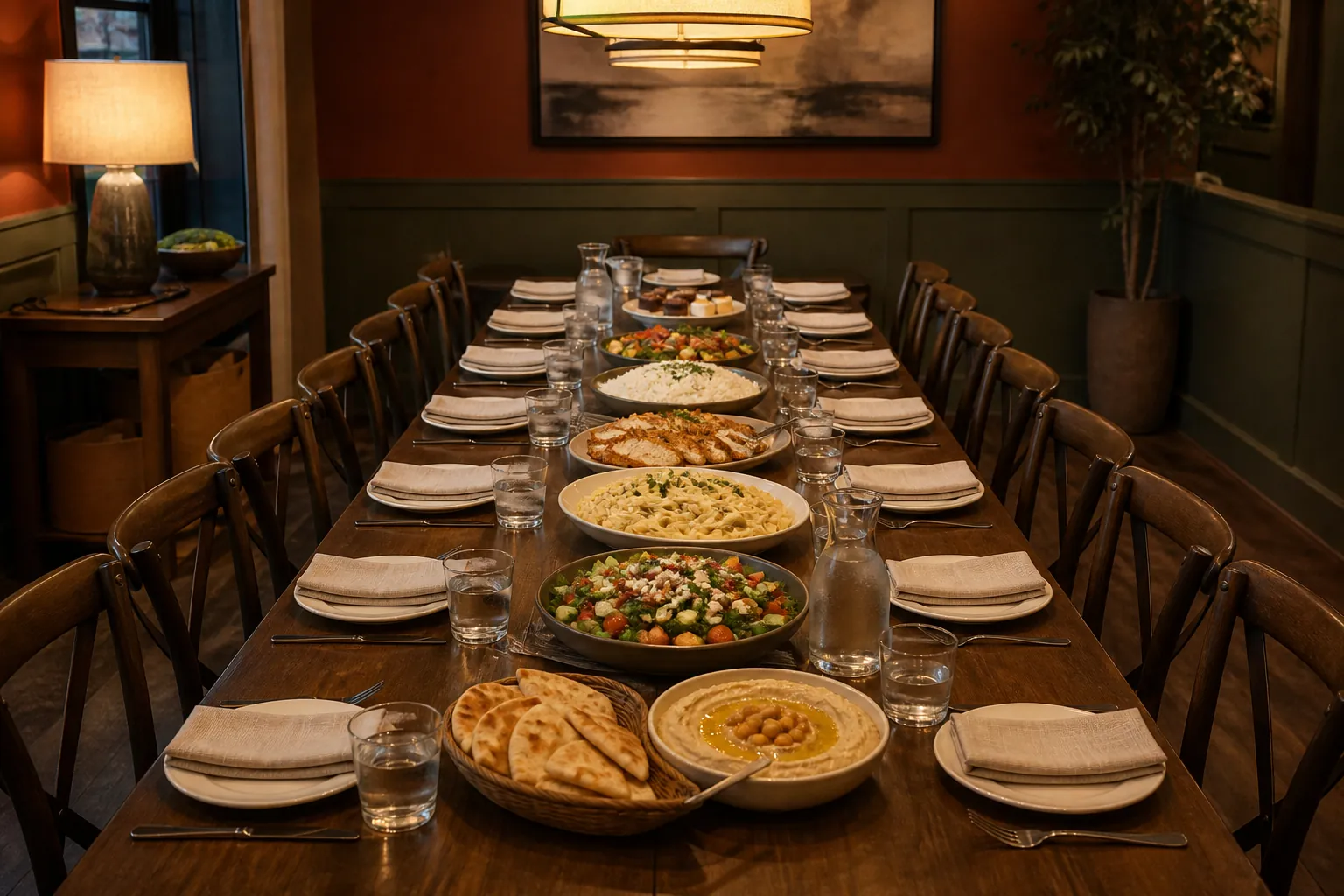
A dinner for eight and a dinner for eighty are both “large groups” in casual conversation. To a restaurant, they are entirely different events.
Eight guests may need one reservation, a comfortable table, and a little extra time to order. Twenty guests introduce more complex seating, arrival, dietary, and payment questions. Fifty guests may require a private-room format, a family-style menu, a room fee, and decisions made well before anyone arrives.
Treating all of those gatherings alike is the fastest way to make planning harder. The first job is not choosing chicken or pasta. It is matching the number of people and type of occasion to the correct restaurant format.
L.A. Bistro Canton is a family-owned Italian and Mediterranean restaurant on Cherry Hill Road with normal table dining, reservations for groups, off-site catering, and published private-event packages. Its current policy asks parties of six or more to reserve by phone. Reserving the entire room requires a minimum of 50 people.
This guide explains what those policies mean in practice, which questions to ask, and how to organize a large-group dinner in Canton without making promises the restaurant has not confirmed.
The guest count decides the planning lane
Before selecting a date, create the most accurate guest estimate available. “About twenty” may mean twelve confirmed guests and eight possibilities, or it may mean twenty confirmed guests plus partners and children. Those scenarios need different conversations.
Count every seat, including children. Identify whether the number is firm, a minimum, or a maximum. Then use the following group-size ladder as a starting point—not as a guarantee of availability.
Six to nine guests: a group reservation
L.A. Bistro asks parties of six or more to reserve by phone. For a group in this range, the likely goal is a standard restaurant table where guests order from the regular menu.
Call with the date, preferred time, exact current count, and any seating or accessibility needs. Ask how the restaurant would like to handle changes. Do not assume that adding “just two more” on the day will be simple; the original table may have been arranged around the confirmed number.
Ten to twenty guests: a coordinated large table
At this size, arrival timing, table layout, menu pacing, and payment become more important. Call rather than attempting to split the group across several unrelated online bookings. Explain whether everyone will arrive together and whether the dinner marks a birthday, team gathering, or family occasion.
A table for twelve may be possible on one date and difficult on another. The restaurant’s ability to accommodate the group depends on the room, other reservations, staffing, and time. Only the restaurant can confirm what is available.
Twenty-one to forty-nine guests: discuss the format early
This range is too large to treat casually, but it does not meet L.A. Bistro’s currently published 50-person minimum for reserving the entire room. Call early and describe the occasion honestly. Ask what dine-in format, date, time, or alternative the restaurant can support.
Do not advertise a “private room” to guests until the restaurant has confirmed one. If an on-site plan cannot match the count, catering at a home, office, community space, or other venue may be the more practical path.
Fifty or more guests: an entire-room event
L.A. Bistro’s current private event information says that reserving the entire room requires a minimum of 50 people. Published packages use family-style service with a room fee and preselected course choices.
At this size, the event is no longer a normal dinner reservation. The host needs to confirm availability, package, guest count, menu selections, total price, timing, and all restaurant policies directly before sending invitations or collecting money.
Choose one coordinator
Large-group dinners become confusing when five people contact the restaurant separately. Choose one coordinator who gathers information, speaks for the group, and records what has been confirmed.
The coordinator does not need to control every detail. Their role is to create one reliable channel between the restaurant and the guests.
That person should know:
- The event date and acceptable alternatives
- The preferred start and end time
- The confirmed count and maximum possible count
- The number of children, if relevant
- Mobility, seating, or accessibility needs
- Dietary needs that require a restaurant answer
- Whether guests expect individual ordering or family-style food
- Whether the gathering needs privacy
- Who is paying and what payment questions must be clarified
- Whether there will be gifts, brief remarks, or another planned moment
After each conversation, write down the staff member’s name, the date, and what was agreed. A clear note is more useful than a group chat full of partial recollections.
Decide whether the event is dinner, private dining, or catering
These three formats solve different problems.
A regular group dinner
Guests sit together in the main restaurant and typically choose from the regular menu. This format preserves individual choice and suits smaller large groups. It may involve more ordering time and more complex payment questions.
An entire-room family-style event
Guests share a selected menu in a reserved room format. This creates a more unified experience and makes service more predictable for a large count. L.A. Bistro currently publishes two family-style packages for entire-room reservations of at least 50 guests.
Off-site catering
The food goes to another location while the host controls the room, schedule, décor, seating, and non-food logistics. L.A. Bistro’s catering menu includes trays, per-piece appetizers, salads, sides, rollups, baguettes, sandwiches, and other group choices.
The right format depends on what matters most. If guests need individual entrées, a regular dinner may be preferable. If privacy and one shared menu matter, an entire-room event may be the answer. If the guest count or activity does not fit the restaurant space, catering may provide more flexibility.
Understand the currently published private-event packages
Pricing and package details can change, so the banquet hall page and a direct phone conversation are the authoritative sources when you are ready to book. As currently published, L.A. Bistro offers two family-style options for entire-room reservations with at least 50 guests.
The $36-per-person package currently includes hommous, a choice of Mediterranean or Caesar salad, two sides, one chicken entrée, and one pasta. The page lists a $600 room fee and an all-in total of $2,868 for 50 people.
The $42-per-person package currently expands the appetizer selection and allows two appetizer choices, along with a salad, two sides, one chicken entrée, and one pasta. It also lists a $600 room fee and an all-in total of $3,246 for 50 people.
The phrase “all-in” on the current page is paired with totals described as everything out the door. Still, hosts should ask the restaurant to restate exactly what is included in the written quote for their event. Do not calculate a guest budget from an article alone.
Important questions include:
- Is the quoted total based on the guaranteed count or final attendance?
- When is the final count due?
- What tax, gratuity, service, deposit, or cancellation terms apply?
- How are children counted?
- Are substitutions available?
- Can dietary meals be handled separately?
- What time does room access begin and end?
- What payment schedule is required?
The article can help a host prepare. The restaurant’s confirmed agreement governs the event.
Build a group menu around contrast and coverage
Family-style food works best when the selections are different enough to serve a range of appetites. Choosing Alfredo pasta, cream-sauce chicken, mashed potatoes, and another rich dish may please some guests but make the menu feel repetitive.
Use four types of contrast:
- Fresh and rich: a Mediterranean or Caesar salad beside pasta and chicken
- Creamy and tomato-forward: Alfredo or Palomino pasta balanced with a brighter entrée or salad
- Soft and crisp: rice or mashed potatoes beside vegetables and a breaded chicken choice
- Familiar and distinctive: Chicken Parmesan or Fettuccine Alfredo alongside Almond Chicken, Sami’s Special, or Firecracker Chicken
For the current $36 package, hommous provides the shared opening. The group then chooses one salad, two sides, one entrée, and one pasta. For the $42 package, two appetizers let the host create more contrast before the main meal.
Consider the group rather than the host’s personal favorites. A corporate dinner may benefit from moderate, widely recognizable flavors. A family celebration familiar with Firecracker Chicken may welcome more heat. A graduation gathering with many ages may need one especially approachable pasta and chicken selection.
Dietary needs require names and numbers
“We have a few dietary restrictions” is not enough information for a restaurant to plan. Gather specifics privately and summarize them accurately.
Ask guests to report allergies, vegetarian needs, vegan needs, halal requirements, and other medically or personally important restrictions by a deadline. Do not ask people to post private health information in a large group chat. Give them a direct way to contact the coordinator.
Then provide the restaurant with counts and details:
- Two vegetarian guests who consume dairy
- One guest with a severe nut allergy
- Three guests asking about halal-certified meat
- One child with a specific food allergy
L.A. Bistro’s regular menu identifies several vegetarian dishes and specifically labels certain steak, lamb, and burger meat as halal-certified. A private-event package has different selections, and cross-contact questions require direct kitchen guidance. Never assume that a regular-menu option can automatically be added to a package or that one label answers every preparation concern.
The coordinator should return the restaurant’s answer to the individual guest without rewriting it into a stronger promise.
Plan the arrival, not just the reservation time
A 6:30 p.m. reservation does not mean fourteen people should begin looking for parking at 6:30. Tell guests when to arrive and distinguish that time from when everyone should be seated.
For a regular large table, ask whether the restaurant seats incomplete parties and what happens if several guests are late. For a private event, clarify when the room opens to the host and when guests should enter.
Choose one person to greet arrivals if the occasion includes guests who do not know one another. Keep coats, gift bags, and strollers from blocking walkways. If elderly guests or people with mobility needs are attending, communicate seating requirements before the room is arranged.
An organized arrival protects the meal’s pacing. Appetizers cannot serve their purpose when half the group is still texting from separate parking lots.
Seating can help or hurt the occasion
At a dinner for eight, seating may be informal. At a gathering for fifty, placement affects conversation, accessibility, and service.
Do not create a complicated chart unless the event needs one. Instead, identify essential placements: children near their caregivers, guests with mobility needs in accessible seats, the guest of honor where they can see and be heard, and people with serious dietary needs where servers can communicate clearly.
If speeches or announcements are planned, ask whether the room layout supports them. Do not bring amplification equipment, decorations, or furniture plans without permission. The restaurant needs to protect guest safety, service paths, walls, and other operations.
Payment questions belong before the meal
Never assume a restaurant can produce twenty separate checks, accept payment from several people, divide one package in a particular way, or process a surprise collection at the end.
Ask how payment works for the selected format. For a normal group dinner, clarify whether separate checks are available and whether there are limits. For a private event, ask about deposit, schedule, accepted payment methods, final balance, and the person authorized to make changes.
If the host is collecting money from guests, calculate a buffer only after receiving the restaurant’s confirmed terms. Communicate whether the payment covers food alone or the entire event. A vague “everyone owes about $50” can create tension when taxes, gratuity, room fees, or add-ons appear later.
Financial clarity is part of hospitality. Guests relax when they understand the arrangement before arriving.
Give the evening a light structure
A large dinner does not need a formal program, but it benefits from a few shared moments.
A simple sequence might be:
- Guests arrive and settle
- The host gives a brief welcome
- Appetizers and salad are served
- Main dishes arrive family style
- One planned remark, toast without alcohol, presentation, or acknowledgment occurs after entrées
- Dessert and informal conversation close the evening
Keep remarks short unless the event is specifically designed around a program. Restaurant food and service have their own pacing. A surprise twenty-minute speech can leave hot food cooling or staff waiting to clear.
Share the basic plan with the restaurant. If a cake, gift presentation, video, or outside vendor is involved, get permission and understand the rules before the day.
Four group-dinner scenarios
A team or company dinner for ten
Use a standard large-table reservation if the restaurant confirms it. Provide the exact count, time, and payment plan. Let guests order individually from the main menu, but collect serious dietary needs in advance. Keep any work remarks brief so the dinner still feels social.
An extended-family dinner for eighteen
Call early and ask what table arrangement is possible. Include children in the count. Preview menu categories so every generation has likely choices. One or two shared appetizers can create a common start, while individual entrées handle different appetites. Our family dinner guide offers age-specific ordering suggestions.
A graduation celebration for thirty-five
This count does not meet the current 50-person entire-room minimum. Ask the restaurant what on-site option, date, or time it can support without assuming privacy. Compare that answer with catered trays at another venue. Choose the format before invitations describe the event.
A birthday or shower for fifty or more
Review the private-event packages, choose a coordinator, request availability, and obtain confirmed terms. Build the menu around guest needs, set response deadlines, and give the restaurant the final count when required. Use the events page to start the conversation, not as a substitute for it.
A large-group planning timeline
The exact lead time depends on availability and event complexity, but the order of decisions is consistent.
First: define the occasion, approximate count, preferred dates, and budget range.
Next: call the restaurant, learn which format fits, and ask about availability and terms.
Before inviting: confirm the date, room or table arrangement, menu structure, price framework, and any deposit requirement.
After inviting: track responses and collect dietary and accessibility needs.
Before the deadline: finalize menu choices, guest count, seating essentials, timing, and permitted extras with the restaurant.
Several days before: remind guests of the address, arrival time, parking expectations, payment arrangement, and coordinator contact.
On the day: arrive at the agreed host time, bring the confirmation, and let one person communicate changes.
Starting early does not mean making every choice immediately. It means discovering the decisions before they become emergencies.
Questions to ask when calling
Use this list as a conversation guide:
- Is our preferred date and time available for the current guest estimate?
- Which format fits this group size?
- What is the maximum or minimum count for that format?
- When must we guarantee the final number?
- Can the group order individually, or is a selected menu required?
- What deposit, fee, tax, gratuity, and cancellation terms apply?
- How are children counted?
- How does the restaurant address our specific dietary needs?
- What seating and accessibility options are available?
- Can guests use separate checks, if applicable?
- When can the host and guests arrive?
- What decorations, cakes, equipment, or vendors are permitted?
- Who should receive final changes?
The best call ends with fewer assumptions, not simply a date written on the calendar.
Frequently asked questions
Does L.A. Bistro take large-group reservations?
Yes. The posted policy asks parties of six or more to reserve by phone. Availability and format depend on the count, date, time, and restaurant operations.
How many people are required to reserve the entire room?
The current published minimum is 50 guests. Confirm that policy and availability directly before making plans because event terms can change.
Does L.A. Bistro offer family-style event menus?
Yes. The restaurant currently publishes two family-style packages for qualifying entire-room events. Each includes course selections, per-person pricing, a room fee, and a published all-in total for 50 guests.
What if our group has fewer than 50 people?
Call with the exact count and ask what regular dining arrangement may be available. Do not assume a private room. For larger groups that do not fit on site, catering at another venue may be worth comparing.
Can L.A. Bistro cater a large gathering elsewhere?
Yes. The catering menu offers trays and group portions across several categories. Contact the restaurant about notice, quantities, availability, pickup or other logistics rather than treating an individual takeout order as catering.
Let the format do the hard work
The most important large-group dinner decision is not which pasta to choose. It is selecting a format that can carry the guest count.
For six or more, call about a reservation. As the group grows, add coordination around arrivals, dietary needs, seating, pacing, and payment. When the count reaches the current 50-person threshold, compare the entire-room family-style packages. When the restaurant is not the right physical format, bring the food to another venue through catering.
L.A. Bistro Canton is located at 44314 Cherry Hill Road. Review the reservation policy, private event overview, full banquet package choices, and catering menu. Then designate one coordinator and call (734) 392-7028. A large group becomes manageable when one clear plan reaches every seat.