
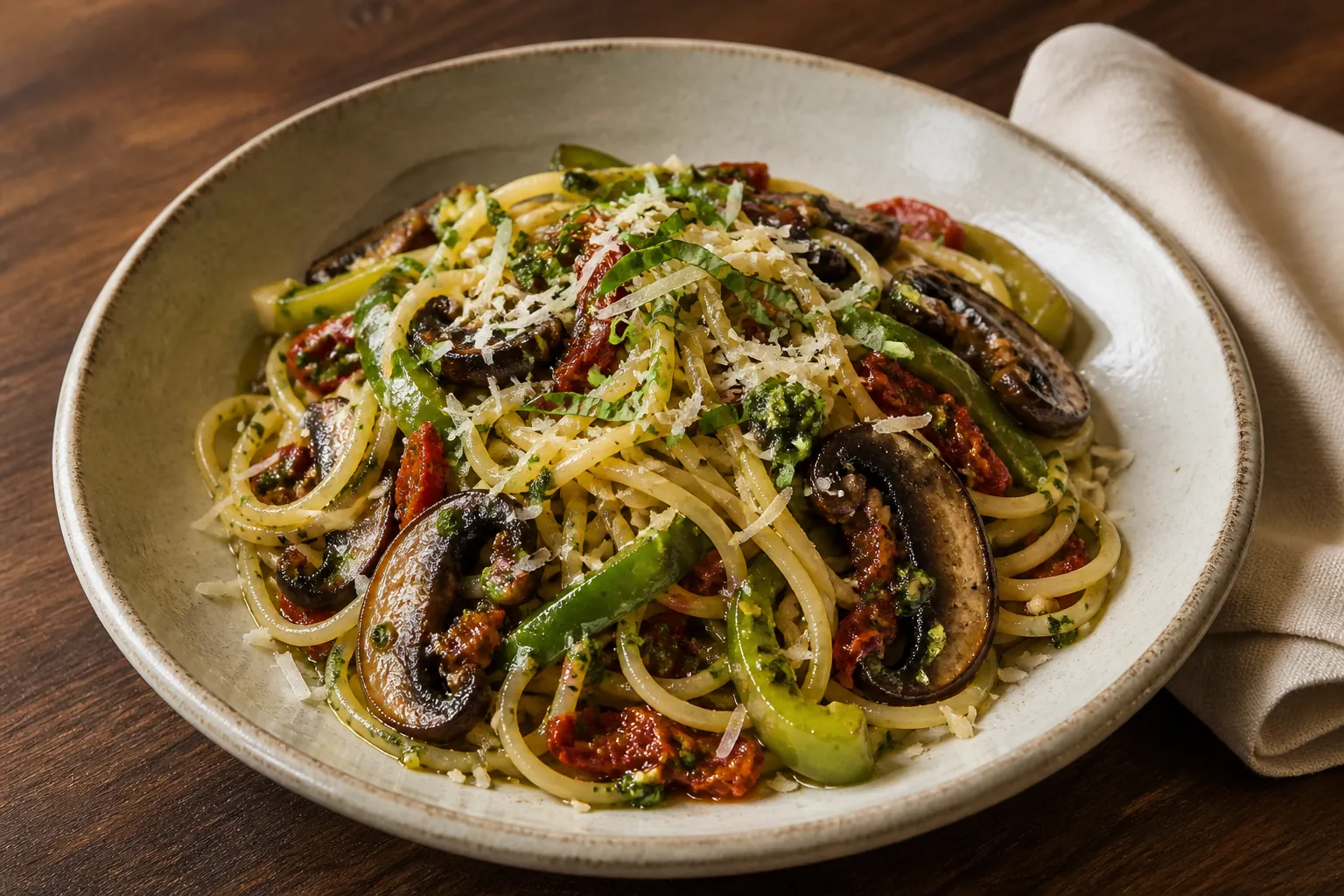
Some diners see “aglio olio” and picture an almost bare bowl: spaghetti, garlic, oil, and little else.
That is not the plate described on L.A. Bistro Canton’s menu.
Here, Spaghetti Aglio Olio is a house twist built with Portobello mushrooms, sun-dried tomatoes, green pepper, chopped garlic, and pesto, all tossed with spaghetti in olive oil and garlic, then topped with shredded Parmesan and fresh basil. The menu marks it both Bistro Favorite and Vegetarian.
The dish still depends on the direct appeal of garlic and oil, but it does not stop there. Mushrooms add depth. Sun-dried tomatoes add concentrated sweetness and acidity. Green pepper provides freshness and bite. Pesto and basil bring an aromatic green layer. Parmesan finishes the bowl with salt and savoriness.
For Canton diners deciding between creamy pasta, red sauce, and something more vegetable-led, this is the menu’s middle path: substantial without relying on Alfredo, tomato-rich without being marinara, and vegetarian without being plain.
Read the name, then read the description
“Aglio” means garlic, and “olio” means oil. Those two ingredients establish the foundation, but a dish name does not promise one universal restaurant recipe.
L.A. Bistro explicitly calls its version a twist on an Italian classic. That phrase matters. Ordering by memory of another restaurant’s aglio olio can create the wrong expectation. Ordering from the published ingredient list tells you what makes this Canton version distinctive.
The current description names:
- Spaghetti
- Portobello mushrooms
- Sun-dried tomatoes
- Green pepper
- Chopped garlic
- Pesto
- Olive oil and garlic
- Shredded Parmesan
- Fresh basil
Each ingredient has a separate job. The bowl makes the most sense when you understand how those jobs overlap.
First note: garlic is the foundation, not a garnish
Garlic appears twice in the short menu description: chopped garlic is included among the tossed ingredients, and the spaghetti is tossed in olive oil and garlic.
That signals a garlic-forward pasta. The flavor is meant to travel with the noodles, not appear as one decorative clove on top.
Olive oil distributes garlic across the spaghetti and gives the strands sheen and separation. Unlike a thick cream sauce, oil does not hide the shape of the pasta. Unlike marinara, it does not cover every ingredient in tomato. Mushrooms remain mushrooms, peppers remain peppers, and sun-dried tomatoes keep their concentrated identity.
Choose this dish when garlic is a feature you actively want. If you only tolerate a faint garlic background, ask whether the kitchen can adjust the preparation before ordering. A diner should not expect a dish named for garlic to behave like a neutral buttered pasta.
Garlic sensitivity is also different from an allergy. Explain the actual concern to the restaurant rather than using those terms interchangeably.
Second note: Portobello mushrooms provide depth
Portobello mushrooms give the pasta a savory, earthy center.
Their broad slices offer more chew than the spaghetti and more moisture than Parmesan. They also absorb oil, garlic, pesto, and the flavors around them. A forkful with mushroom therefore feels different from one made only of noodles and basil.
This is one reason the entrée works as a vegetarian main course rather than a side. The mushroom creates a substantial component without pretending to imitate meat.
It also gives diners a clear preference test. If Portobello mushrooms are a favorite, this pasta places them within nearly every part of the meal. If mushrooms are unwanted, this is not the most natural menu choice. Removing a central ingredient can leave the intended balance incomplete.
Mushroom lovers who want a creamier direction can compare this dish with Zip Sauce Fettuccine Alfredo or the mushroom-filled Ravioli Di Portobello. The Palomino sauce guide for Canton explains how those ravioli change with creamy tomato and other sauce choices.
Third note: sun-dried tomatoes concentrate the tomato flavor
Sun-dried tomatoes do not turn this into marinara pasta.
Their role is smaller and more concentrated. Instead of coating the spaghetti in a uniform tomato sauce, they appear as distinct bites with sweetness, acidity, and a pleasantly chewy texture.
That means a diner can want “some tomato” without wanting a red-sauce entrée. The sun-dried tomato punctuates the garlic and oil rather than replacing them.
It also creates visual and flavor contrast with the green components. Basil, pesto, and green pepper lean fresh and aromatic; sun-dried tomato pulls the bowl toward deeper, warmer notes.
If tomato avoidance is medically necessary, ask about pesto and every other prepared component as well as requesting removal of visible pieces. If tomato is simply a preference, consider whether the dish would still deliver the sweet-acidic contrast the kitchen intended without it.
Fourth note: green pepper keeps the bowl lively
Green pepper contributes freshness, a faint bitterness, and a firmer vegetable bite.
That crisp-tender texture matters in a bowl where spaghetti, cooked mushrooms, pesto, and oil could otherwise feel uniformly soft. Pepper breaks the pattern.
The flavor is also direct. Green pepper does not disappear into garlic or Parmesan. Diners who enjoy it may appreciate how it keeps the meal from becoming too rich. Diners who strongly dislike it should notice that the menu names it plainly.
This is a useful distinction from David Allen Pasta, which includes mixed vegetables with penne and Alfredo sauce. Both offer vegetables, but one uses a garlic-oil base with individually named Portobello, tomato, and pepper; the other uses a creamy sauce and a mixed-vegetable format.
Fifth note: pesto connects the vegetables
Pesto is the bridge between the oil-based pasta and the fresh basil finish.
It brings an herb-forward coating to portions of the spaghetti and helps green flavor travel beyond individual basil leaves. The menu does not publish the complete pesto recipe, so diners should not assume exact ingredients from the name alone.
Traditional expectations may suggest basil, cheese, nuts, garlic, and oil, but restaurant recipes vary. Someone avoiding tree nuts, dairy, or another ingredient should ask specifically what L.A. Bistro’s current pesto contains and how it is handled. “Vegetarian” is not the same as nut-free, dairy-free, vegan, or allergen-free.
The combination of pesto and chopped garlic also means the pasta carries more aromatic intensity than a plain oil coating. That is part of its Bistro Favorite personality.
Sixth note: Parmesan and basil finish in opposite ways
Shredded Parmesan and fresh basil arrive at the end, but they do different work.
Parmesan adds a salty, savory, dry texture over the glossy noodles. Basil adds fragrance and a fresh green top note. One deepens; the other lifts.
The published vegetarian badge is consistent with the restaurant’s classification of the current dish. Individual vegetarian standards can differ, however, particularly around cheese production. If your standard excludes certain enzymes or preparation methods, ask about the exact Parmesan rather than relying on the category badge alone.
For a dairy restriction, requesting no visible Parmesan may not be enough because pesto can also require ingredient verification. For vegan dining, both Parmesan and the pesto recipe need a direct conversation, along with pasta ingredients and shared preparation.
How the six notes form one bite
The dish is best understood as a sequence rather than a pile of toppings.
The spaghetti carries olive oil and garlic. Portobello mushrooms bring earthiness. Sun-dried tomato adds concentrated brightness. Green pepper interrupts with freshness. Pesto supplies an herb-rich thread. Parmesan and basil finish the forkful.
Not every bite will contain all six. That variation is an advantage. A cream sauce can make every noodle taste deliberately uniform. This preparation lets individual ingredients appear and disappear as the meal progresses.
Before eating, gently turning the spaghetti through the bowl can redistribute oil, pesto, garlic, and vegetables that settled during plating or travel. The goal is not to mash the components together. It is to prevent the first few forkfuls from taking all the mushrooms while the final ones hold only noodles.
Is this the lighter pasta choice?
It may feel brighter than Alfredo, but “oil-based” should not be treated as a nutritional calculation.
Olive oil, pesto, and Parmesan all contribute richness. Portion size and any protein addition change the meal further. L.A. Bistro’s current menu does not publish calories, sodium, fat, or other nutrition values for the dish.
Use sensory language instead:
- It is not coated in a cream sauce.
- It is not tossed in marinara.
- It includes several vegetables.
- It uses olive oil, garlic, pesto, Parmesan, and basil for flavor.
- It can remain vegetarian as listed or become protein-centered through an add-on.
Those facts help a diner choose without making unsupported health claims.
Keep it vegetarian or add a protein?
The base Spaghetti Aglio Olio is labeled vegetarian. The current pasta menu also allows protein additions, including almond or grilled chicken, six shrimp, steak bites, N.Y. strip, filet, and ribeye.
Adding protein does more than increase quantity. It changes the center of the meal.
Keep the base vegetarian
Choose the dish as listed when the vegetables, garlic, pesto, and oil are the point. This preserves the contrast among Portobello, sun-dried tomato, green pepper, and herbs.
It also makes the pasta useful at a table where one diner wants a substantial vegetarian entrée while others order chicken, seafood, steak, or lamb.
Add grilled chicken for a mild savory layer
Grilled chicken can fit without dominating the garlic-and-pesto direction. It adds protein and char while leaving the vegetables visible.
The current add-on line does not label the chicken halal-certified. Ask about the exact chicken and preparation rather than transferring certification from separate steak and lamb menu items.
Add almond chicken for crisp texture
Almond chicken creates the strongest textural contrast: breading and thin almond slices against glossy spaghetti. It also introduces tree-nut, wheat, egg, frying, and shared-equipment questions.
Read the Canton guide to Detroit-style almond chicken before choosing that route, and speak directly with the restaurant if allergies matter.
Add shrimp for seafood and garlic
Shrimp pairs naturally with garlic, oil, and herbs. Six pieces create a countable addition that can be distributed through the pasta.
This route is distinct from Linguine Frutti Di Mare, which combines shrimp, scallops, and mussels with a choice of spicy marinara or lemon garlic cream. Aglio Olio with shrimp is the vegetable-and-garlic path, not the mixed-shellfish path.
Add steak only when steak should become the center
Steak bites can distribute beef through the noodles. N.Y. strip, filet, or ribeye can transform the order into steak accompanied by vegetable-filled pasta.
Those larger additions introduce a major shift in richness and price. Ask how the current pasta add-on is portioned and presented, and verify product and halal certification for the exact order. Named steak entrées elsewhere on the menu have their own detailed descriptions; a short add-on line should not be assumed identical in every respect.
A four-way pasta decision in Canton
If the full pasta menu makes choosing difficult, identify the sauce family first.
Choose Spaghetti Aglio Olio for garlic, olive oil, pesto, mushrooms, green pepper, sun-dried tomato, Parmesan, and basil.
Choose Fettuccine Alfredo for a uniform creamy sauce and broad noodles. The Canton Fettuccine Alfredo guide maps every current protein addition.
Choose Penne Palomino for creamy marinara, basil, and a short pasta shape.
Choose Diavolo Pasta for spicy marinara, linguine, zucchini, and Portobello mushrooms.
The decision is not “white sauce or red sauce” anymore. Aglio Olio occupies the garlic-oil-and-herb lane between them.
Build the rest of dinner around contrast
The pasta section currently offers an added house salad, Caesar salad, or cup of soup. Check the current menu for availability and pricing.
A house salad can reinforce the vegetable direction while adding cool crispness. Caesar repeats Parmesan and may introduce additional dairy, egg, or fish-derived ingredient questions depending on the current dressing. Soup varies, so ask what is available and what it contains.
For appetizers, avoid repeating every main ingredient unless that is deliberate. A Portobello-heavy opening followed by Portobello pasta can make the meal feel narrower. A creamy appetizer can provide contrast, but it also increases richness. A shared shrimp starter followed by vegetarian Aglio Olio lets the table taste seafood without changing the entrée itself.
The Italian and Mediterranean food guide for Canton can help build a meal across hommous, salads, pasta, grilled entrées, and desserts without forcing every course into one category.
Allergy and dietary questions to ask clearly
Because this pasta contains several prepared and fresh components, “Is it vegetarian?” is only one question—and the menu already answers that with its badge.
Depending on your needs, ask:
- Does the current pesto contain tree nuts or dairy?
- What kind of Parmesan is used?
- Does the spaghetti contain egg?
- Are wheat pasta and allergen-sensitive orders handled with shared water, cookware, or utensils?
- Can green pepper, mushrooms, sun-dried tomato, pesto, or Parmesan be modified?
- Are any prepared components made with ingredients not stated in the short menu description?
- How are protein add-ons cooked, and what equipment do they share?
For halal requirements, ask about pesto, Parmesan, cooking ingredients, and shared preparation as well as any added protein. The vegetarian label does not automatically answer every halal question. The halal Italian dining guide for Canton provides a fuller verification framework.
Menus, suppliers, and recipes can change. Contact L.A. Bistro before visiting when a restriction is serious, then confirm again while ordering.
How Aglio Olio travels for takeout
Oil-based spaghetti behaves differently from Alfredo in a takeout container.
The sauce does not thicken like cream, but oil, pesto, and vegetable moisture can settle. Spaghetti can clump as it cools. Mushrooms and peppers continue softening while enclosed, and Parmesan can melt into the noodles.
For a better takeout result:
- Pick up close to the time you plan to eat.
- Keep the container flat during the drive.
- Gently turn the spaghetti through the oil and vegetables on arrival.
- Reheat only if necessary, using brief and gentle intervals.
- Avoid overheating fresh basil and vegetables.
- Refrigerate leftovers promptly and follow current food-safety guidance.
If protein is added, account for it separately. Shrimp can firm up, grilled chicken can dry, breaded almond chicken can soften, and steak can move past the desired doneness with aggressive reheating.
The final read on L.A. Bistro’s Aglio Olio
Order this dish because you want the twist, not in spite of it.
L.A. Bistro Canton’s Spaghetti Aglio Olio is a garlic-and-olive-oil pasta with an entire vegetable and herb arrangement built into the bowl. Portobello mushrooms make it savory. Sun-dried tomatoes concentrate brightness. Green pepper provides bite. Pesto links the oil to the herbs. Parmesan and basil finish the noodles in opposite but complementary directions.
Keep it vegetarian when those ingredients are enough. Add grilled chicken, almond chicken, shrimp, steak bites, or a full steak only when you want the protein to redefine the meal.
Review the current L.A. Bistro pasta menu, ask the dietary questions that apply to you, and find this vegetable-packed garlic pasta on Cherry Hill Road in Canton, Michigan.